

Shared Prom Ride Services: What Parents and Students Need to Know
Discover the benefits of shared prom ride services, ensuring safety, coordination, and affordability for students on prom night.
A shared prom ride service is a single chauffeur-operated vehicle, such as a party bus, sprinter van, or shuttle, that transports students from multiple households along a coordinated pickup route on prom night. Instead of one family booking an entire vehicle, several students split the cost and the seats. Here are three things to confirm before you book any shared prom ride:
- Operator credibility: Look for a licensed, locally established provider like APEX LIMO, which specializes in event transportation with a documented safety record.
- Commercial insurance: The vehicle must carry commercial auto liability coverage, not a standard personal policy.
- Driver background checks: Every chauffeur should have a verified criminal background check on file, available to parents on request.
Key Takeaways
A shared prom ride service is the most cost-effective way to move a large group safely on prom night, but it requires clear contracts, locked headcounts, and verified operator credentials to work well.
| Point | Details |
|---|---|
| What "shared" means | Multiple students split one vehicle, one route, and one total cost, typically $31–$77 per person for a party bus. |
| Top three safety checks | Confirm commercial insurance, driver background checks, and a current vehicle inspection before paying any deposit. |
| Lock headcount early | Finalize passenger count and collect all payments 7–10 days before prom to prevent no-show cost gaps. |
| Shared vs. private | Shared rides suit groups of 10 or more on a budget; private booking is better for small groups needing timing control. |
| APEX LIMO | Offers DOT-inspected, insured, and chauffeur-driven prom vehicles in Austin with written contracts and multi-stop routing. |
Table of Contents
- What is a shared prom ride service, and how does it work?
- Benefits parents and students get from a shared prom ride
- Common drawbacks and risks worth knowing before you commit
- How does a shared prom ride compare to private options?
- What does a shared prom ride typically cost, and how much should you tip?
- Safety checks every parent should make before booking
- What experienced event transport providers recommend before you book
- How to book a shared prom ride: step-by-step
- Splitting costs and setting conduct expectations
- When should you choose a shared prom ride vs. private transport?
- Why professional chauffeur services insist on contracts and clear rules
- APEX LIMO makes prom night transportation straightforward
- Useful sources and further reading
- A note on what the contracts actually protect
What is a shared prom ride service, and how does it work?
The "shared" part simply means multiple students, often from different families or even different schools, ride in the same vehicle under a single booking. One group organizes the reservation, sets a pickup schedule, and divides the total cost. The operator handles routing, timing, and on-night logistics. Think of it as a private charter with a split bill rather than a public bus with strangers.
Typical booking flow:
- One student or parent contacts the operator with the date, pickup addresses, passenger count, and itinerary (photo stop, dinner, venue, after-party).
- The operator provides a quote, collects a deposit (usually 25–50% of the total), and sets a headcount and final-payment deadline, typically 7–10 days before prom.
- Each family pays their share directly to the organizer or through a payment app.
On prom night, the routing works like this:
- The chauffeur follows a pre-agreed multi-stop pickup sequence, usually timed in 5–10 minute windows per stop.
- Seat assignments may be informal or pre-set depending on the operator, but total capacity is fixed. A 20-passenger party bus carries 20 people, not 21.
- The driver manages the route, monitors timing, and enforces the operator's conduct rules. A chaperone, if included, supports the driver but does not replace the operator's authority.
Pro Tip: *Confirm your exact pickup window in writing and ask whether the operator sends a live tracking link or text alerts. Knowing the vehicle is three stops away removes a lot of prom-night anxiety for parents waiting at home.*
Event-transport operators consistently advise sharing a full itinerary with the chauffeur in advance to avoid delays and unexpected charges.
Benefits parents and students get from a shared prom ride
The cost argument is the most obvious one. A party bus that costs $600 for four hours splits to $30 per person across 20 riders. The same vehicle booked privately by a group of four costs $150 each. That gap matters when students are also paying for tickets, dinner, and photos.
Beyond the money, there are real practical and safety advantages:
- Group experience: Everyone arrives together, which is part of the point on prom night. No one is stuck waiting for a rideshare that canceled.
- Single pickup and drop-off: Parents know exactly when and where the vehicle leaves and returns. There is no coordinating five separate cars.
- Professional supervision: A licensed chauffeur is a sober, accountable adult in the vehicle for the entire night. That is a meaningful safety layer that a parent-driven carpool or a rideshare app cannot replicate.
- Environmental footprint: One large vehicle replacing eight or ten individual cars is a straightforward reduction in emissions, even if it is rarely the top reason families choose this option.
Professional prom transport providers note that vehicles range from stretch limousines and SUV limos to party buses and sprinter vans, all designed for group coordination and safety on event nights.
Common drawbacks and risks worth knowing before you commit
Shared rides are not the right fit for every group, and going in with clear expectations prevents most of the friction.
Reduced control is the most common complaint. You cannot change the music to something only your group likes, make an unplanned stop, or leave the venue 30 minutes early without affecting everyone else on the route. The schedule is collective.
Last-minute dropouts create real problems. If two students back out the week before prom, the remaining riders absorb their share unless a replacement is found quickly. This is more disruptive in a small group of eight than in a group of twenty.
Extra stops lengthen the trip. A route with six pickup addresses can add 30–45 minutes to what looks like a short drive on a map. Students at the first stop sit longer; students at the last stop feel rushed.

Behavioral risks are a legitimate parental concern. Alcohol, rowdiness, and property damage happen more often in large mixed groups than in small private bookings. Reputable operators enforce a zero-tolerance alcohol policy and will stop the vehicle if conduct rules are violated, but enforcement depends on the operator's standards and whether an adult chaperone is present.
Pro Tip: *Ask the operator for a written conduct agreement that all passengers sign before the night. It sets expectations clearly and gives the driver authority to act without ambiguity if a problem arises.*
How does a shared prom ride compare to private options?
The choice usually comes down to group size, budget, and how much control the group needs over timing and atmosphere.
| Dimension | Shared prom ride | Private limo or party bus | Individual rideshare |
|---|---|---|---|
| Cost per person | Low ($25–$50+ depending on group size) | Higher ($75–$200+ per person for small groups) | Variable, often unpredictable on prom night |
| Privacy and control | Limited, shared with other students | Full control over music, stops, and timing | Full control, but no group experience |
| Capacity and group size | Best for 10–30+ students | Best for 4 students | 1–4 per vehicle |
| Supervision and chaperone | Chauffeur present; chaperone optional | Chauffeur present; family controls chaperone | No supervision |
| Pickup flexibility | Fixed multi-stop route, limited changes | Flexible, on your schedule | On-demand, but surge pricing and cancellations are common |
| Risk and liability | Shared conduct risk; operator enforces rules | Operator enforces rules, fewer variables | No operator oversight; driver not event-trained |
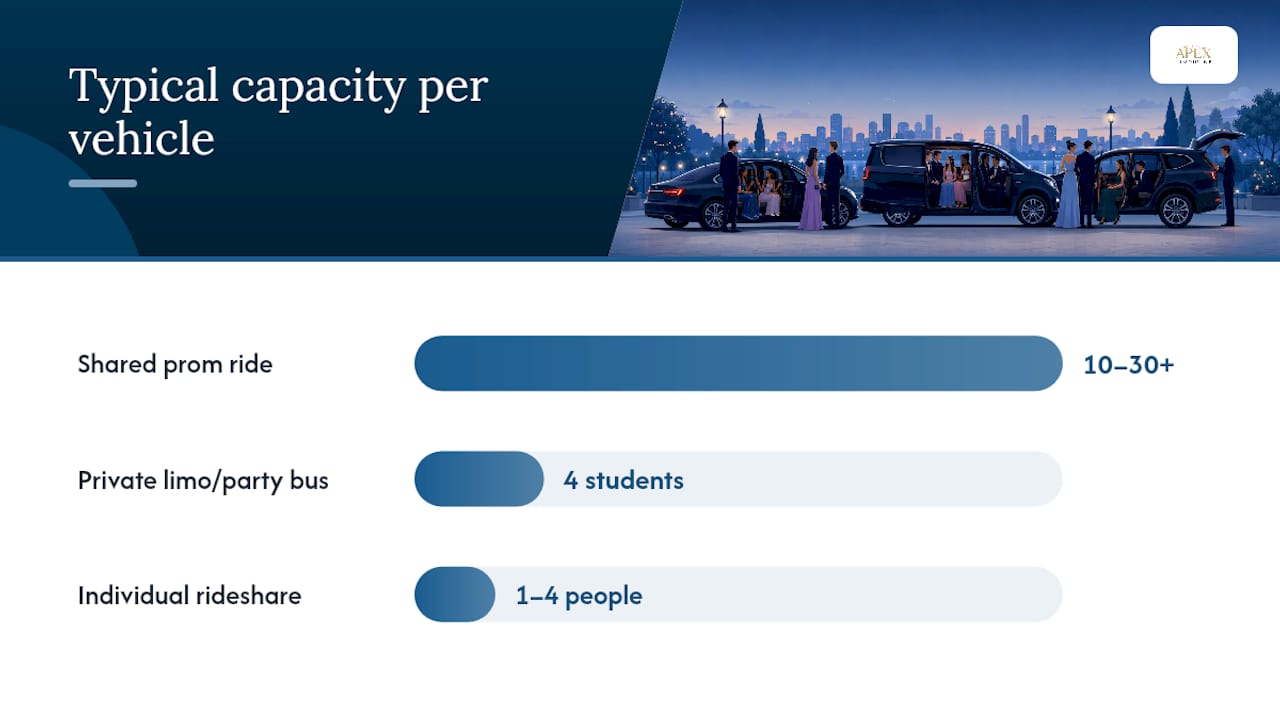
A shared ride makes the most sense for larger mixed groups where budget is a priority and everyone can agree on a single itinerary. Private booking is the better call for a small group of close friends who want full control, a family that needs a specific pickup time, or a situation where one family is coordinating everything and does not want to manage other people's payments and schedules.
For a deeper look at how chauffeured services compare to rideshare models for event nights, this breakdown of limo services vs. ride-sharing covers the practical trade-offs clearly.
What does a shared prom ride typically cost, and how much should you tip?
Pricing for prom transportation is almost always per vehicle, not per person. The group pays a total, then divides it.
Typical hourly rates by vehicle type:
- Stretch limousines: roughly $75–$150 per hour
- SUV limousines: roughly $125–$300 per hour
- Party buses (20–30 passengers): often starting around $250 per hour
Most operators require a minimum booking of 3–4 hours on prom night, so a party bus at $250 per hour with a four-hour minimum runs $1,000 before gratuity and fees. Split across 20 riders, that brings the per-person cost into the range of roughly $31–$77, depending on the total hours and any add-on charges.
On tipping: Chauffeur tipping guides recommend 15–20% for multi-hour prom bookings, or a flat fee in the $20–$100 range for longer events. For a shared ride, the group typically pools the tip and presents it as a single amount at the end of the night. Build it into the per-person cost calculation from the start so it does not become an awkward conversation at midnight.
> Cost callout: On a $1,000 party bus booking split 20 ways, each rider's base share is $50\. Add a 20% tip ($200 total, or $10 per person) and any fuel surcharge or tax, and the realistic per-person total lands around $65–$75\. That is a useful planning number.
Prices vary significantly by market, vehicle age, and prom-night demand. General limo pricing references confirm that rates spike during prom season, so booking early is not just convenient, it is cheaper.
Safety checks every parent should make before booking
This is the section most parents skip because they assume a licensed company is automatically safe. Do not assume. Ask directly.
Driver credentials:
- Request proof of a commercial driver's license (CDL) or the appropriate state endorsement for passenger transport.
- Ask whether the company runs criminal background checks on all drivers and whether those checks are repeated annually.
Insurance:
- The operator must carry commercial auto liability insurance. Ask for a certificate of insurance naming the vehicle and coverage amount. A personal auto policy does not cover commercial passenger transport.
Vehicle documentation:
- Confirm the vehicle has passed a DOT inspection or equivalent state safety inspection within the required period.
- Ask for the vehicle's capacity rating. An operator who quotes a 25-passenger bus but tries to seat 30 is a red flag.
Operator policies:
- Zero-tolerance alcohol policy: confirmed in writing?
- Chaperone rules: does the operator require or recommend one?
- Emergency procedures: what happens if the vehicle breaks down or a student becomes ill?
- Overtime and cancellation terms: what are the fees, and what is the refund policy if the event is canceled?
Pro Tip: *Request a written itinerary, an emergency contact number for the on-call dispatcher, and a live tracking link before prom night. APEX LIMO's prom safety guide for parents lists exactly which documents to request and what each one covers.*
What experienced event transport providers recommend before you book
Professional chauffeur services that handle prom bookings regularly have seen what goes wrong when groups skip the paperwork. The problems are predictable: late pickups because the address was never confirmed, overcapacity because the headcount changed at the last minute, and alcohol incidents because no one established the rules in writing.
APEX LIMO's pre-booking checklist for shared prom rides:
- Written contract with the vehicle type, capacity, pickup addresses, schedule, and total price itemized
- Passenger manifest submitted to the operator at least 7 days before prom
- Confirmed pickup windows for each stop (not just "around 6 PM")
- Clear chaperone policy in the contract: who is responsible, what authority they have, and what happens if they cancel
How professional chauffeurs handle multi-school pickups:
Routing multiple schools or neighborhoods requires coordination that goes beyond a GPS app. Experienced operators build buffer time between stops, account for traffic patterns on prom night, and communicate with a single parent contact rather than fielding calls from 20 different families. APEX LIMO's prom booking guidance covers how this coordination works in practice, including how chauffeurs handle venue arrival timing and post-prom drop-offs.
Service-level expectations to hold operators to:
- Text or app-based alerts when the vehicle is en route to each stop
- On-call dispatcher reachable by phone throughout the night
- Proof of commercial insurance and DOT inspection available before the booking is finalized
Pro Tip: *Lock the final headcount and collect all payments at least 7–10 days before prom. Late additions and last-minute dropouts are the single biggest source of cost disputes and no-show gaps. APEX LIMO's group booking guide walks through exactly how to structure this deadline with your group.*
How to book a shared prom ride: step-by-step
Getting quotes:
Contact at least two or three operators with the same information: date, pickup addresses in order, total passenger count, full itinerary with times, and any special requests (decorations, specific music setup, accessible vehicle). This lets you compare apples to apples.
What to confirm before paying a deposit:
- Deposit amount and whether it is refundable
- Final payment deadline
- Cancellation and refund policy (what percentage is returned if you cancel 30 days out vs. 7 days out)
- Overtime fees if the night runs long
Questions to ask every operator:
- Can you provide proof of commercial insurance and a current vehicle inspection?
- What is the driver's licensing and background check status?
- What is the exact vehicle model, year, and passenger capacity?
- Do you provide live tracking or text alerts during the event?
- What is your policy if the vehicle breaks down or the driver is unavailable?
Documentation to insist on:
- Signed contract with all terms, not just an email confirmation
- Itemized invoice showing base rate, gratuity, taxes, and any fees
- Written contingency plan for delays or mechanical issues
Pro Tip: *Assign one parent as the day-of contact for the operator. Ask the operator for photos of the meeting point at each pickup address so students know exactly where to stand. It sounds minor, but it eliminates confusion when 15 teenagers are trying to find a party bus on a busy street.*
Local family-focused providers consistently recommend a single parent coordinator as the most effective way to keep communication clean on prom night.
Splitting costs and setting conduct expectations
Fair cost-splitting approaches:
- Even split: Total cost divided by the number of passengers. Simple and transparent.
- Pay-per-seat: Each student pays for their confirmed seat regardless of whether they show up. This protects the group from absorbing a dropout's share.
- Sliding share for organizers: The student who organized the booking sometimes receives a small discount as compensation for the coordination work. This is informal but common.
Payment logistics:
Collect all payments through Venmo, Zelle, or a group payment app at least one week before prom. Set a hard deadline and communicate it clearly. Anyone who has not paid by the deadline loses their seat to a replacement. This sounds harsh, but it prevents the most common shared-ride dispute.
Conduct rules operators typically enforce:
- No alcohol or controlled substances, period
- No smoking inside the vehicle
- No standing through sunroofs while the vehicle is moving
- Respect the vehicle's interior (no food that stains, no glitter)
- Be at your pickup location on time; the driver will not wait more than 5 minutes
Handling a dropped passenger:
If someone cancels after the payment deadline, the group has two options: find a replacement rider who pays that share, or redistribute the cost among remaining passengers. Decide the policy before anyone drops out so there is no argument later. APEX LIMO's group booking guidance covers how to structure this in the initial group agreement.
When should you choose a shared prom ride vs. private transport?
Use this checklist to match your situation to the right option:
- Group of 10 or more students: Shared ride almost always wins on cost and logistics.
- Budget under $60 per person: A shared party bus or shuttle is likely your only realistic option for a professional vehicle.
- Mixed friend groups from different households: Shared rides handle multi-stop pickups naturally; private bookings get complicated fast.
- Need strict timing or a single-family experience: Private booking gives you full control. No waiting on other stops, no shared conduct risk.
- Privacy matters more than cost: Private limo or SUV is the right call for a small group that wants its own atmosphere.
Pro Tip: *If your group has even one student with a strict curfew or a parent who needs the vehicle back at a specific time, negotiate a guaranteed return window with the operator in writing before you book. Shared rides run on collective schedules, and a 20-minute delay at the venue affects everyone.*
For a full breakdown of vehicle options by group size and budget, this guide to prom night transportation types covers the practical differences between party buses, SUVs, and stretch limos.
Why professional chauffeur services insist on contracts and clear rules
The operators who have the fewest problems on prom night are the ones who treat every booking like a legal document, not a handshake. Written contracts and passenger manifests are not bureaucratic overhead. They are the mechanism that prevents the three most common prom-night failures: late pickups caused by unconfirmed addresses, overcapacity caused by last-minute additions, and alcohol incidents caused by unclear enforcement authority.
Background checks and commercial insurance serve a similar function. They do not just protect the students in the vehicle. They protect the families from liability if something goes wrong and protect the operator from claims they cannot defend. A company that cannot produce a certificate of insurance on request is telling you something important about how it operates.
The practical examples are consistent across the industry. A group that submits a passenger manifest and locks headcount 10 days out almost never has a no-show gap. A group that waits until the day before prom to finalize the list almost always does. Clear rules about alcohol and conduct, stated in writing and acknowledged by every passenger, give the chauffeur the authority to act decisively if a problem starts, rather than hesitating because the policy was never formalized.
APEX LIMO's approach to prom transportation is built around exactly this framework: documented standards, verified drivers, and a communication structure that keeps parents informed without requiring them to manage the night themselves.
APEX LIMO makes prom night transportation straightforward
For families in Austin who want a shared prom ride done right, APEX LIMO offers party buses, luxury SUVs, and sprinter vans sized for groups of all sizes, each with DOT-inspected vehicles, commercially insured and background-checked chauffeurs, and a written contract for every booking.

What sets APEX LIMO apart from a generic booking platform is the event-specific coordination: multi-stop pickup routing, real-time tracking, a single on-call dispatcher for the night, and a prom checklist that walks your group through headcount deadlines, payment terms, and conduct agreements before the night begins. You are not handed a vehicle and a driver. You get a managed event transport experience with accountability built in at every step.
Request a quote or view the fleet to get a prom-night price for your group size and itinerary. If you want to compare SUV options for smaller groups, the luxury SUV fleet page shows capacity and configuration details.
Useful sources and further reading
These resources cover the specific topics parents and students most often need when planning prom transportation:
- Prom Limo Service Austin for Safe Luxury Rides — Practical booking guidance and what to expect from a professional prom limo service in Austin.
- Top Chauffeur Services for Prom Night — Breaks down chauffeur-level service options, vehicle choices, and safety expectations for prom night.
- Types of Prom Night Transportation — Compares party buses, SUVs, stretch limos, and shuttles by capacity and group fit.
- Limo Driver Tipping Guide — Standard tipping ranges (15–20% or flat fee) for multi-hour prom bookings, with guidance on pooling the tip as a group.
---
A note on what the contracts actually protect
*By Jason*
Most parents focus on the fun details when booking prom transportation: the vehicle size, the sound system, whether there is a sunroof. The paperwork feels like a formality. It is not.
The contract is the only thing that gives a chauffeur clear authority to enforce conduct rules without a confrontation. It is the only document that specifies what happens if a student does not show up, if the vehicle runs over the booked hours, or if the event venue changes the exit time. Without it, every one of those situations becomes a negotiation at midnight, when everyone is tired and some students may be difficult.
The operators who handle prom nights well are not the ones with the flashiest vehicles. They are the ones who ask the most questions upfront, who push back when a group tries to add passengers past capacity, and who send a written itinerary three days before the event rather than waiting for the family to ask. That operational discipline is what separates a professional chauffeur service from a car with a driver.
Parents who treat the safety checklist as optional are taking on risk that a signed contract would have transferred to the operator. The background check, the insurance certificate, the DOT inspection record: these are not requests that a legitimate company will find unreasonable. Any operator who resists providing them is telling you something worth hearing before prom night, not after.
Recommended
- Top Chauffeur Services for Prom Night: Safe, Stylish Rides
- Prom Limo Safety Features: 2026 Parent and Student Guide
- Why Parents Should Vet Limo Companies for Prom Night
- Prom Transportation Contract: 2026 Parent and Student Guide
Explore Austin executive chauffeur services for your trip.
Our Services
Serving Austin and surrounding Central Texas communities. View all service areas →
Ready to Book?
Experience Austin in Luxury
Get a personalized quote for your Austin transportation needs — wedding, airport, corporate, or a night out.
Get a Free Quote