

Prepare for executive airport transfer in 2026 with our guide. Ensure smooth travel with expert tips on coordination and logistics.
An executive airport transfer is defined as an operational plan, not a booked ride, designed to deliver punctual, professional transportation through flight tracking, chauffeur briefing, and real-time coordination. Business executives who treat ground transportation as a logistical afterthought consistently face the same problems: missed connections, confused pickups, and cascading schedule failures. The difference between a smooth arrival and a stressful one comes down to preparation. This guide covers exactly how to prepare for executive airport transfer situations, from confirming reservation details to managing delays and meet-and-greet protocols.
How to prepare for your executive airport transfer
Preparation for an executive airport transfer begins well before the day of travel. Executive transfers are operational plans requiring flight tracking, dispatch oversight, and chauffeur preparedness. That means the work starts the moment a booking is made, not the morning of departure.
The most common failure point is unconfirmed assumptions. An executive assumes the driver knows the terminal. The driver assumes the flight is on time. Neither checks. The result is a 20-minute delay that pushes back a board meeting. Checklists eliminate these assumptions by forcing confirmation of every variable before wheels are in the air.

Success in executive travel depends less on vehicle quality and more on protecting schedule and momentum through detailed ground transportation planning. A luxury sedan stuck at the wrong terminal is no better than a taxi. The vehicle is secondary to the plan.
What information do you need before booking?
Getting the reservation details right is the foundation of every smooth transfer. Reservations must include the traveler's exact name format, flight number, local time zone, pickup and drop-off locations, passenger count, and luggage profile. Missing any one of these creates friction at the worst possible moment.
Here is the full pre-booking checklist every executive or executive assistant should complete:
- Traveler name: Match exactly to the ID being used for travel
- Flight details: Airline, flight number, origin city, and scheduled arrival time in local time
- Terminal or FBO information: Terminal-specific access such as arrivals hall, baggage claim, curbside, or FBO ramp determines where the chauffeur stages
- Passenger and luggage count: Number of travelers and bag types affect vehicle selection
- Pickup and drop-off addresses: Full addresses with suite numbers, building names, or venue access notes
- Chauffeur contact details: Direct number for the assigned driver, not just a dispatch line
- Meet-and-greet instructions: Whether the chauffeur waits inside arrivals, at baggage claim, or curbside
Pro Tip: *Save all reservation details in a shared document or travel app like TripIt or Concur so both the executive and the assistant can access them from any device during travel.*
The table below shows the most common reservation gaps and their consequences:
| Missing Detail | Likely Consequence |
|---|---|
| Wrong terminal listed | Chauffeur stages at wrong pickup point |
| No luggage count | Vehicle too small for bags |
| No meet-and-greet instructions | Executive waits at curb, driver waits inside |
| Flight number missing | No real-time tracking possible |
| No chauffeur direct contact | Communication fails during delays |
How do you coordinate an executive transfer step by step?
Coordination is where preparation becomes execution. A confirmed reservation is only the starting point. The steps below protect on-time arrivals from booking through drop-off.
- 1.Reconfirm 24 hours before travel. Best practice requires reconfirming pickup 24 hours in advance, verifying that the executive has their itinerary, ID, and boarding pass ready. This is also the moment to confirm the chauffeur's name and direct contact number.
- 2.Monitor flight status in real time. Flight tracking with live dispatch oversight allows dynamic pickup staging for early arrivals and delay adjustments for late flights, improving punctuality. Apps like FlightAware and FlightRadar24 give minute-by-minute updates that a professional dispatch team should already be monitoring.
- 3.Stage the vehicle early. For inter-meeting transfers, have the vehicle arrive 10 minutes before the scheduled pickup. For airport arrivals, the chauffeur should be in position before the flight lands, not after.
- 4.Confirm communication availability. The executive should have the chauffeur's number saved before boarding. The chauffeur should have a backup contact, typically the executive assistant, in case the executive's phone is off or delayed through customs.
- 5.Prepare contingency routes. Ground transportation is the last and first control point of an executive itinerary. Detailed route review, traffic monitoring, and contingency plans minimize cascading delays. A professional service should have alternate routes mapped before departure.
- 6.Adjust plans promptly for changes. If a flight diverts or a meeting shifts, the executive or assistant must notify dispatch immediately. Waiting until landing to communicate a two-hour delay wastes staging time and can cost the booking.
Pro Tip: *Use a step-by-step transfer guide to build a repeatable coordination checklist your team can use for every trip, not just high-stakes ones.*
How should you handle delays and meet-and-greet protocols?
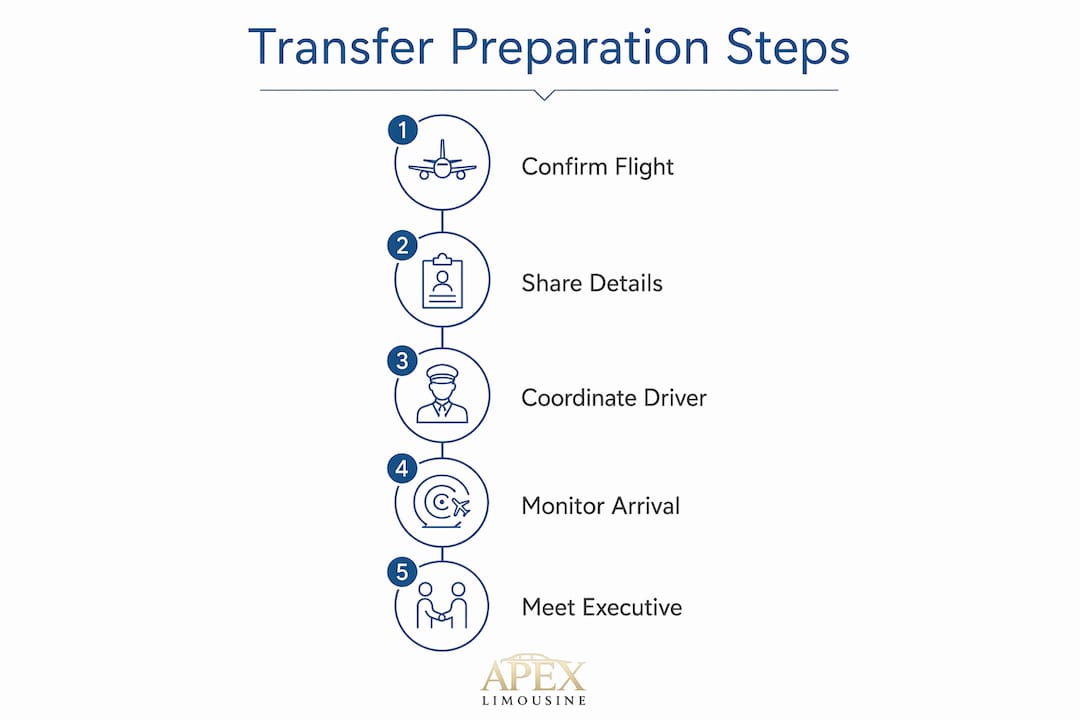
Delays are not exceptions in executive travel. They are standard operating conditions. Delays of 30–60 minutes post-landing are common due to taxiing, immigration, and baggage handling, and must be managed proactively. A professional transfer service accounts for this in its waiting time policy.
Here is how to handle the most common disruption scenarios:
- Flight delay before departure: Notify dispatch as soon as the delay is confirmed. A good service rebases the pickup time on the new estimated arrival, not the original schedule.
- Extended post-landing wait: Airport transfers often include complimentary waiting time post-landing. Ask your provider exactly how long that window is and what the policy is for extended waits beyond it.
- Meet-and-greet location confusion: Confirm in advance whether the chauffeur meets inside the arrivals hall, at baggage claim, or curbside. Inside terminal pickups reduce confusion significantly, especially at large airports like Austin-Bergstrom International.
- Schedule buffer after landing: Plan a buffer of 15–20 minutes after scheduled airport arrival before the first appointment. This accounts for customs, baggage, and unexpected delays without putting the entire day at risk.
> *The meet-and-greet is not a courtesy. It is a coordination mechanism. A chauffeur holding a name sign inside arrivals eliminates the single most common cause of post-landing confusion: the executive and driver searching for each other in opposite directions.*
For professional airport meet-and-greet service, the chauffeur should be briefed on the executive's appearance, preferred greeting style, and any special instructions before the flight lands.
Executive transfer vs. standard airport ride: what is the difference?
The difference between an executive airport transfer service and a standard airport ride is not just the vehicle. It is the operational layer behind it. Compared to standard transfers, executive chauffeur services provide professional vetting, centralized corporate billing, flight status monitoring, and meet-and-greet tailored for executives. That operational layer is what protects a schedule.
| Feature | Standard Transfer | Executive Transfer |
|---|---|---|
| Flight monitoring | Fixed pickup time only | Real-time tracking with dynamic staging |
| Chauffeur vetting | Basic background check | Professional training, briefing, and dress standards |
| Meet-and-greet | Curbside only | Inside terminal, baggage claim, or FBO ramp |
| Itinerary changes | Rebooking required | Flexible adjustments with dispatch coordination |
| Corporate billing | Per-trip payment | Centralized accounts with reporting |
| Contingency planning | None | Alternate routes and backup contacts pre-mapped |
The executive airport-to-venue transfer category specifically covers the full journey from wheels-down to the meeting room door. That scope requires a provider who treats the transfer as a managed service, not a point-to-point ride. For teams traveling together, treating transfers as operational plans for groups requires even more coordination across multiple flights and schedules.
Key takeaways
Preparing for an executive airport transfer requires operational planning, confirmed reservation details, real-time flight monitoring, and clear meet-and-greet protocols to protect every minute of a business schedule.
| Point | Details |
|---|---|
| Treat transfers as operations | Confirm flight details, terminal access, and chauffeur briefing before travel day. |
| Use a pre-booking checklist | Capture traveler name, flight number, luggage count, and meet-and-greet instructions every time. |
| Monitor flights in real time | Use FlightAware or dispatch tracking to adjust pickup timing dynamically for delays. |
| Build in schedule buffers | Allow 15–20 minutes after landing before the first appointment to absorb post-landing delays. |
| Clarify waiting time policies | Ask your provider how long complimentary waiting time lasts and what happens beyond that window. |
Why most executives underestimate ground transportation
I have watched executives spend weeks preparing a board presentation and 90 seconds booking their airport ride. That imbalance is where schedules fall apart. Ground transportation is the first and last thing you control in a travel day. Everything in between, the flight, the weather, the customs line, is outside your hands. The pickup is not.
The executives I have seen handle travel best share one habit: they treat the transfer confirmation call the same way they treat a pre-meeting briefing. They verify the driver's name, the staging location, the contingency contact, and the route. That call takes four minutes. It prevents the kind of 40-minute delay that no apology email fixes.
The other mistake I see constantly is assuming that a luxury vehicle means a professional service. It does not. A well-briefed driver in a clean sedan outperforms an unbriefed driver in a stretch SUV every time. The briefing is the product. Reliable executive transfers account for curbside congestion, alternate routing, and active dispatch. That is what you are actually paying for.
> *— Jason*
How APEX LIMO handles your executive airport transfer
APEX LIMO delivers executive airport transfers in Austin as fully managed operations, not simple bookings. Every reservation includes real-time flight tracking, professional chauffeur briefing, and meet-and-greet service at Austin-Bergstrom International Airport.

APEX LIMO's dispatch team monitors your flight from departure and adjusts staging dynamically for early or delayed arrivals. Chauffeurs are briefed on your schedule, preferred pickup point, and contingency contacts before you board. Corporate accounts include centralized billing and flexible itinerary adjustments with no rebooking friction. For executives who need every minute of their travel day protected, APEX LIMO's Austin luxury transportation service is built for exactly that standard.
FAQ
What is an executive airport transfer service?
An executive airport transfer service is a professionally managed transportation operation that includes flight tracking, chauffeur briefing, meet-and-greet protocols, and contingency planning. It differs from a standard ride by providing operational oversight from booking through drop-off.
How far in advance should you book an executive transfer?
Book at least 24–48 hours in advance and reconfirm the reservation 24 hours before travel. Last-minute bookings risk vehicle unavailability and insufficient time for chauffeur briefing.
What should an airport transfer checklist include?
A complete checklist covers traveler name, flight number, terminal or FBO access details, passenger and luggage count, chauffeur contact, meet-and-greet location, and a contingency contact number.
How do executive transfer services handle flight delays?
Professional services use real-time flight tracking to rebase pickup timing automatically when flights are delayed. Most providers include complimentary waiting time post-landing to cover taxiing, immigration, and baggage delays.
What is the difference between curbside pickup and meet-and-greet?
Curbside pickup places the chauffeur outside the terminal at a designated zone. Meet-and-greet places the chauffeur inside the arrivals hall or baggage claim with a name sign, which reduces confusion and is standard for executive airport pickup.
Recommended
- Executive Airport Transfer Austin for Teams | Apex Limo
- Why Apex Limo's Airport Transfers Guarantee a Stress-Free Arrival | Apex Limo
- Austin Airport Limo Service: The Complete Guide to AUS Transfers | Apex Limo
- Executive Sedan Service Austin for Premium Travel | Apex Limo
Plan the Complete Journey
For the complete planning framework, see our Austin corporate transportation guide.
Explore Austin airport transportation for your trip.
Our Services
Serving Austin and surrounding Central Texas communities. View all service areas →
Ready to Book?
Experience Austin in Luxury
Get a personalized quote for your Austin transportation needs — wedding, airport, corporate, or a night out.
Get a Free Quote