
Quick Answers
- For company meetings, off-sites, conferences, board dinners, client entertainment, and holiday parties, transportation is often the operational detail that determines whether the event feels polished or chaotic.
- The first mistake many planners make is booking vehicles based only on the main venue. A better approach is to list every movement attendees will actually make.
- Document each transportation segment, including:
Corporate events run smoother when transportation is planned as carefully as the agenda. Here is a practical Austin-specific framework for coordinating guest arrivals, executive transfers, shuttles, and departure waves without last-minute confusion.
Apex Limo fleet and beverage policy: Our Classic Stretch Limousine (Chrysler 300) seats up to 8 passengers; our SUV Stretch Limousine seats up to 12. Service is BYOB (bring your own beverages); champagne and other beverages are not included. Alcohol is for guests age 21 and over only. General examples and other operators' offerings below do not change these limits or inclusions.
Corporate event transportation Austin: key takeaways
- Start transportation planning as soon as your venue, attendee count, and agenda are confirmed.
- Build the plan around arrival windows, venue access, executive movements, and departure waves, not just vehicle counts.
- In Austin, traffic patterns around Downtown, The Domain, Austin-Bergstrom International Airport, and major event venues can change timing significantly.
- Use a mixed fleet when needed: executive sedans for VIPs, luxury SUVs for leadership teams, Sprinter vans for small groups, and larger vehicles for shuttle loops.
- A single transportation point of contact helps avoid missed pickups, venue congestion, and schedule drift.
Why corporate event transportation planning matters in Austin
For company meetings, off-sites, conferences, board dinners, client entertainment, and holiday parties, transportation is often the operational detail that determines whether the event feels polished or chaotic. In Austin, that is especially true. Executive arrivals from Austin-Bergstrom International Airport, guest movement between Downtown hotels and venues, and traffic around corridors like MoPac, I-35, and Loop 360 can affect the entire event timeline.
Strong corporate event transportation Austin planning does more than move people from one address to another. It protects the schedule, improves the guest experience, and gives your team a clean, professional arrival process. For executive and event transportation across Austin and Central Texas, Austin Apex Limo helps companies coordinate sedans, SUVs, Sprinter vans, stretch limousines, party buses, and shuttle-style solutions with a premium service standard.
If your event includes airport arrivals, a welcome reception, a dinner at a Downtown restaurant, or a Hill Country retreat, transportation should be mapped as part of the event design itself, not treated as a last-minute add-on.
Step 1: Define the event movement, not just the event location
The first mistake many planners make is booking vehicles based only on the main venue. A better approach is to list every movement attendees will actually make.
Build your movement map
Document each transportation segment, including:
- Airport pickups from AUS
- Hotel-to-venue transfers
- Executive point-to-point service
- Off-site dinner transportation
- Multi-stop client entertainment routes
- Late-evening departures back to hotels or residences
- Return trips the following morning
For example, a corporate event at The Driskill, JW Marriott Austin, or Fairmont Austin may require a very different transportation plan than an off-site program at Omni Barton Creek Resort & Spa or a private venue in the Texas Hill Country. If your event schedule includes multiple locations, every transition needs its own timing, staging, and vehicle assignment.
For venue logistics and city access planning, it is helpful to review official local resources such as https://www.austintexas.gov and airport information at https://www.austintexas.gov/airport.
Step 2: Segment your passengers by service level
Not every attendee should be assigned to the same transportation type. The cleanest plans separate guests by role, schedule sensitivity, and experience expectations.
Typical corporate groups to separate
- VIPs and executives: individual sedans or luxury SUVs
- Speakers and key clients: direct transportation with tighter timing
- General attendees: grouped shuttle movements
- Internal staff and production teams: practical movement schedules with equipment considerations
- Social-event guests: return transportation after dinners, receptions, or celebrations
This segmentation prevents overbooking premium vehicles for general shuttle use while ensuring leadership and client-facing guests receive timely, discreet service.
| Transportation need | Recommended vehicle type | Best use case |
|---|---|---|
| Executive airport arrival | Executive sedan or luxury SUV | CEO, board member, keynote speaker, top client |
| Small team transfer | Mercedes Sprinter van | Hotel-to-venue movement for 8-14 guests |
| VIP group arrival | Luxury SUV or stretch limousine | Hosted clients, sponsor group, evening reception |
| Large social movement | Party bus or group vehicle solution | Corporate celebration, dinner transfer, team outing |
| Multi-stop event support | Dedicated sedan/SUV rotation | Event planner, leadership team, last-minute schedule changes |
Step 3: Build the schedule backward from hard start times
Transportation timelines should be reverse-engineered from the moments that cannot move:
- Registration opening
- Speaker call times
- AV checks
- Meal service
- Award presentations
- Off-site reservation times
- Airport departure windows
Use buffer time intentionally
In Austin, buffer time is not optional. A Downtown pickup during convention activity or a transfer from The Domain to South Congress at the wrong hour can easily disrupt a tight agenda. Build in time for:
- Vehicle staging
- Guest loading and late arrivals
- Hotel valet queues
- Security or venue check-in
- Traffic around major event zones
- Rain-related slowdowns during high-attendance periods
A good working rule is to create separate schedules for guests, VIPs, and event staff, since each group operates on different timing realities.
Step 4: Confirm venue access, loading zones, and staging rules
Transportation plans often fail at the curb, not on the road. Before the event, confirm where each vehicle can legally and practically load or unload.
Questions to answer before dispatch
- 1.Where is the designated passenger loading area?
- 2.Are oversized vehicles or Sprinter vans restricted?
- 3.Is there a separate entrance for VIP arrival?
- 4.Does the venue require a transportation schedule in advance?
- 5.Will hotel valet or security staff need driver names or vehicle descriptions?
- 6.Is there a holding area for standby vehicles?
This is especially important for Downtown Austin properties, event venues near the Austin Convention Center, and high-traffic entertainment zones like Sixth Street, Rainey Street, and South Congress. A transportation provider should know where premium service can be executed smoothly without creating curbside congestion.
Step 5: Match fleet strategy to the event format
Fleet selection should align with the event’s purpose, brand tone, and guest flow. A board dinner, for example, typically calls for quiet executive sedans or luxury SUVs. A company celebration or high-energy team event may benefit from Sprinter vans, stretch limousines, or party buses to keep groups together.
Austin Apex Limo offers a fleet that supports both executive discretion and event-scale coordination, including executive sedans, luxury SUVs, stretch limousines, Mercedes Sprinter vans, party buses, and SUV stretch limos. The right mix depends on whether your priority is privacy, efficiency, image, or group movement.
If you are unsure which configuration fits your event, you can view our fleet or use the AI Concierge to narrow the best option by group size and occasion.
Step 6: Assign one transportation decision-maker
Every successful corporate transportation plan has one central coordinator. That person should control:
- Final manifests
- Pickup times and contact lists
- Venue confirmations
- VIP transportation instructions
- Day-of adjustments
- Communication with the chauffeur team or dispatcher
Without a single decision-maker, conflicting instructions become common. One executive requests an earlier departure, another team adds a stop, and suddenly the original plan no longer works. A centralized point of contact keeps the operation clean and accountable.
Step 7: Prepare contingency plans for day-of changes
Even well-run events change. Flights are delayed. Meetings run long. A dinner shifts by 30 minutes. A guest decides to leave from a different hotel.
Build flexibility into the plan
Prepare for:
- Flight delays into AUS
- Last-minute attendee additions
- Weather disruptions
- Overflow vehicle needs
- Extended standby time for executives
- Split departures after evening events
For higher-level events, it is smart to reserve some flexibility in the schedule rather than running every vehicle on a zero-margin timeline. That protects the guest experience and prevents one delay from cascading across the evening.
Step 8: Reconfirm everything 24 hours before the event
The day-before review is where small issues are caught early. Reconfirm:
- Passenger counts
- Pickup addresses
- Flight details
- Venue loading instructions
- Primary contacts
- Vehicle assignments
- Event end-time expectations
For planners handling multiple moving parts across Austin, Round Rock, Cedar Park, Georgetown, Pflugerville, Lakeway, San Marcos, or the Hill Country, this final confirmation is essential.
A practical standard for polished company-event logistics
The strongest corporate event transportation Austin plans are specific, local, and operationally realistic. They account for Austin traffic, venue access, airport timing, executive expectations, and the fact that business events rarely stay static from first draft to event day.
When transportation is treated as part of the event strategy, guests notice the difference immediately: smoother arrivals, less waiting, better pacing, and a more professional impression from start to finish.
For tailored corporate transportation planning in Austin and Central Texas, contact Austin Apex Limo at 512-890-0900, email info@austinapex.com, or get a quote at https://austinapex.com.
Frequently Asked Questions
How far in advance should I book corporate event transportation in Austin?
Book as soon as your venue, attendee count, and event schedule are reasonably firm. For larger corporate events, earlier planning gives you better fleet availability, cleaner staging logistics, and more time to coordinate airport arrivals, venue access, and executive transportation details without last-minute compromises.
What vehicle types are best for a corporate event in Austin?
It depends on passenger type and event flow. Executive sedans and luxury SUVs work best for VIPs, speakers, and client entertainment, while Mercedes Sprinter vans and larger group vehicles are better for attendee shuttles, hotel transfers, and keeping teams moving together on schedule.
Should corporate event transportation include airport transfers?
Yes, if attendees or executives are flying into Austin-Bergstrom International Airport. Airport pickups create a more controlled guest experience, reduce late arrivals, and help your team manage timing more precisely, especially when key participants are coming in on different flights throughout the day.
What is the most common mistake in corporate event transportation planning?
The most common mistake is planning only for the main venue and ignoring every movement around it. Corporate events usually involve airport pickups, hotel departures, off-site dinners, VIP transfers, and staggered returns, all of which need separate timing, vehicle assignments, and curbside coordination.
Executive Travel Standards and Corporate Accounts
Corporate transportation is also day-to-day business travel. A tracked AUS pickup, a quiet executive sedan between meetings, and a single provider for the return flight reduce the failure points that come with ad-hoc rides. For visiting clients, transportation is part of hospitality: a name-sign greeting, luggage assistance, discreet service, and a vehicle ready for a changing schedule create a professional first impression.
Recurring users should define an account workflow with approved bookers, traveler profiles, consolidated invoices, cost-center or project codes, and one escalation contact. Clear travel policies can set preferred vehicle classes and approval limits while still allowing assistants to change a trip when a flight or meeting moves.
Austin Traffic, Major Events, and Roadshow Timing
Austin distances can be misleading during I-35 and MoPac peaks. Build additional time into airport-to-downtown and cross-town movements, and review the city calendar before confirming a roadshow. SXSW, ACL, Formula 1, UT game days, and major conventions can tighten vehicle supply and change loading access around hotels and venues.
For multi-stop investor or client days, an hourly vehicle hold is often more reliable than ordering a new ride after every meeting. The same chauffeur keeps materials in the vehicle, adjusts the route, and remains accountable for the full itinerary. Book the return AUS leg with the arrival so the last transfer is not left to peak-hour availability.
Hill Country Retreat and Multi-Day Transportation
A retreat needs a movement plan, not just an outbound reservation. Collect flight details, headcount, luggage volume, accessibility needs, hotel assignments, mobile contacts, and preferred arrival windows. Separate leadership or VIP movements from the main attendee group when their schedules differ; sedans and SUVs can handle direct executive transfers while Sprinters or larger vehicles move teams together.
Map every segment before departure: Austin office or AUS pickups, resort check-in, off-site sessions, dinners, winery or activity transfers, and the final return. Hill Country rideshare supply can be inconsistent, especially after evening events, so pre-arranged return windows and a contingency plan for schedule overruns are essential.
Choosing a Corporate Fleet by Group and Assignment
Match each vehicle to the work it needs to do. An executive sedan provides a quiet cabin for one to three travelers, airport transfers, and private client pickups. A luxury SUV gives a three-to-six-person team more luggage room and works well for roadshows or client dinners. A Sprinter van keeps larger teams together for conference shuttles and venue transfers, while a stretch limousine or party bus fits award dinners and hosted events where the arrival is part of the presentation.
Right-sizing is more valuable than defaulting to the most expensive vehicle. Compare the true passenger and luggage count, event formality, privacy requirement, and number of stops. For more capacity guidance, use the vehicle selection guide. Planners comparing recurring vendors can also review what belongs in a corporate transportation RFP, while event teams can use the separate corporate shuttle planning guide.
Across every vehicle class, confirm a clean and current cabin, working climate control, charging access, water, and sufficient luggage space. Operational standards matter just as much: flight tracking for airport movements, one dispatch contact for complex programs, consolidated billing, and written pricing without surge multipliers. A single Sprinter can be simpler than several sedans when one vehicle, one chauffeur, and one invoice can serve the entire team.
Discretion and Privacy for Executive Movements
Discretion protects an executive's identity, conversations, documents, and movements. The vehicle should operate as a controlled work environment, not merely a premium ride. That requires screened chauffeurs, need-to-know handling of passenger and itinerary data, disciplined communication, thoughtful route and arrival planning, and clear confidentiality expectations.
Chauffeur conduct creates what executive travelers often need most: cognitive quiet. The chauffeur avoids unnecessary conversation, does not announce sensitive destinations in public, never discusses previous passengers, and allows private calls or meeting preparation to continue without interruption. These professional chauffeur standards protect both productivity and trust.
Before a sensitive booking, ask the provider to explain its screening, confidentiality, passenger-data, communication, and arrival protocols in writing. Identify whether an NDA or other formal confidentiality agreement is required for the assignment. For a private roadshow, board movement, or high-profile airport arrival, use an Austin executive chauffeur service and share only the operational details each chauffeur needs. Browse Austin limo services for the vehicle classes available for the wider event program.
Additional Planning Details: Corporate Limousine Service in Austin, TX: Elevating Business Travel
Austin: The New Corporate Powerhouse
Over the past decade, Austin has transformed into one of America's premier corporate destinations. Tesla's Gigafactory, Apple's sprawling campus, Oracle's headquarters relocation, and hundreds of tech startups have made Austin a city where first impressions matter — and where executive transportation has become a meaningful business expense.
When your company's leadership or your most important clients are in town, the transportation you provide says something about your organization. Austin Apex Limo helps Austin's top companies make the right statement.
Our Corporate Transportation Services
Executive Airport Transfers
Punctuality is non-negotiable for business travel. Our flight-tracking system ensures your executive or client is never left waiting, and our chauffeurs arrive 15 minutes early — every time. We handle the AUS terminal logistics so your team member can focus on their upcoming meeting.
Client VIP Transfers
First impressions happen at the curb. When your most important client lands in Austin, greet them with a gleaming black Escalade and a professional chauffeur. It's a detail that signals respect and attention to quality.
Corporate Group Transportation
Moving a team of executives between venues, sessions, or events requires precision coordination. Our Sprinter van and fleet of SUVs keep your group together and on schedule — whether it's a board retreat in the Hill Country or a multi-stop day of client meetings across Austin.
Roadshow and Conference Support
Austin hosts major conferences year-round — Dell Technologies World, SXSW, TechCrunch Disrupt, and dozens more. Our team manages complex multi-pickup, multi-destination itineraries so your roadshow runs smoothly from start to finish.
Corporate Event Shuttle Service
Managing guest transportation for a corporate dinner, product launch, or company party? We provide dedicated shuttle service between hotels, venues, and event sites — keeping your event running on schedule and your guests arriving in comfort.
Why Austin Executives Choose Apex Limo
Reliability: We understand that corporate schedules have zero tolerance for tardiness. Our on-time rate is 99.7%.
Professionalism: Our chauffeurs are trained in corporate etiquette. They're discreet, courteous, and understand that your conversations are private.
Productivity: A quiet, comfortable executive sedan is a mobile office. Our vehicles have USB charging at every seat, and our chauffeurs maintain a distraction-free environment.
Account Management: We provide corporate accounts with consolidated billing, ride reporting, and a dedicated account manager — eliminating the administrative burden of individual bookings.
Key Corporate Destinations in Austin
- Tesla Gigafactory (Del Valle)
- Apple Austin Campus (Northwest Austin)
- Oracle Headquarters (West Austin)
- Amazon / AWS Austin (Downtown and suburban offices)
- Austin Convention Center (Downtown)
- The Domain (corporate hotel corridor)
Ready to Set Up a Corporate Account?
Austin Apex Limo offers flexible corporate account arrangements, including monthly invoicing, priority booking for last-minute requests, and volume discounts for high-frequency clients.
Contact us for a corporate transportation proposal and let us become your Austin transportation partner.
Additional Planning Details: Corporate Travel in Austin: Ground Transportation Tips That Save the Trip
Why Austin Is Different
Austin rewards companies that plan ground transportation and punishes the ones that improvise. The city's business core is compact, but it is fed by some of the most congested corridors in Texas — I-35 and MoPac chief among them — and its calendar is stacked with demand spikes that swallow on-demand transportation whole: SXSW in March, ACL over two October weekends, Formula 1 at Circuit of the Americas, UT game days, and a year-round conference schedule.
If you book travel for executives — or you are the executive — these are the tips that keep an Austin itinerary intact.
Check the events calendar before you book anything
The single most common Austin corporate-travel mistake is scheduling a routine trip into SXSW or F1 week unknowingly. Hotel rates triple, restaurants book out, and on-demand rides surge relentlessly. If the dates are fixed, lock ground transportation the moment flights are booked — during major events, pre-arranged cars are the difference between attending your meeting and watching a rideshare app spin.
Build I-35 buffer into every meeting
Distances in Austin lie. Eight miles from the airport to downtown reads like fifteen minutes; at 8:30 a.m. it can be forty. Schedule as if every crosstown leg takes twice the map estimate during peak windows (7–9:30 a.m., 4–7 p.m.), and route around I-35 when possible. A chauffeur who drives Austin daily reroutes around trouble in real time — one less variable for the traveler to manage.
Treat the airport pickup as the first meeting
Nothing sets the tone of a visit like landing to a chauffeur holding a name sign versus twenty minutes in a rideshare lot. For inbound executives and candidates, book a tracked pickup: the car adjusts to the actual landing time, the greeting happens inside the terminal, and the traveler is working from the back seat minutes after wheels-down. Flat-rate pricing also means finance sees one clean, predictable number per transfer.
Make the vehicle part of the itinerary, not a gap between stops
For multi-stop days — investor meetings downtown, a site visit in the Domain, dinner on South Congress — an hourly chauffeured vehicle turns dead transit time into working time and eliminates the four separate rides you would otherwise summon. The car waits; the schedule holds; laptops stay open.
Host clients the way you would want to be hosted
When you are the one hosting, transportation is hospitality. Sending a black corporate car for a client's airport arrival, or moving a visiting team together in one SUV between meetings and dinner, communicates more than any lobby welcome sign. Keep the group in one vehicle — conversations that happen between meetings are often the ones that matter.
Standardize on one provider
Ad-hoc transportation means every trip is a new negotiation: new vendor, new quality gamble, new receipt format. Standardizing corporate ground travel with a single operator gets you consistent vehicles, chauffeurs who learn your travelers' preferences, predictable all-in pricing for finance, and one number to call when a flight diverts at 11 p.m.
Book the return leg at the same time as the arrival
The most commonly dropped ball in corporate travel is the ride *back* to AUS. Departures cluster in the early morning and late afternoon — exactly when demand peaks. Booking both legs together costs nothing extra and removes the trip's last failure point.
The Bottom Line
Austin's growth has outpaced its roads, and its event calendar bends the transportation market several weeks a year. Corporate travelers who pre-arrange ground transportation glide through all of it; those who improvise donate their margin to surge pricing and their schedule to I-35.
Request a corporate quote — tell us your itinerary and headcount, and we'll confirm exact all-in pricing within 24 hours.
Additional Planning Details: Corporate Retreat Transportation Austin Guide
Corporate retreat transportation Austin: what matters most
When an Austin company heads to the Texas Hill Country for a retreat, transportation is usually the first operational detail people underestimate. A retreat itinerary may include airport arrivals at Austin-Bergstrom International Airport, executive departures from Downtown Austin offices, check-in windows at a resort in Lakeway or Dripping Springs, off-site dinners, and the return trip two or three days later. Corporate retreat transportation Austin planning works best when those moving parts are managed as one system, not as separate rides.
Key takeaways
- Match vehicle type to both passenger count and luggage volume, not headcount alone.
- Build a shared transportation schedule around flight arrivals, hotel check-in, dinner reservations, and meeting start times.
- Use a single transportation partner for airport transfers, resort shuttles, and multi-day standby service to reduce gaps and miscommunication.
- For Hill Country retreats, plan extra buffer time for winding roads, dispersed venues, and weather-related delays.
- Austin Apex Limo can coordinate executive sedans, SUVs, Sprinter vans, stretch limousines, party buses, and SUV stretch limos for Austin and Central Texas itineraries.
Why Hill Country retreat logistics are different from a standard meeting transfer
A one-way airport pickup is simple. A corporate retreat to the Texas Hill Country is not. Popular retreat destinations often spread attendees across multiple arrival windows and multiple properties, from resorts near Lake Travis to wineries and ranch venues in Driftwood, Dripping Springs, Wimberley, or farther toward San Marcos.
That matters because your team may need:
- Airport pickups from AUS for executives and out-of-state staff
- Office departures from Downtown Austin, The Domain, or North Austin
- Grouped transfers to a retreat venue in the Hill Country
- Evening transportation to dinners, tastings, or team events
- Late-night return service back to the hotel or lodge
- Final-day departures timed to flights, office returns, or staggered checkouts
Austin Apex Limo helps companies consolidate these legs into one coordinated plan so attendees are not left arranging rides individually at the last minute.
Choosing the right vehicle mix for group size and luggage
The biggest transportation mistake on retreat day is booking based on seats only. Multi-day corporate travel means rolling luggage, garment bags, presentation materials, branded welcome kits, golf clubs, or event supplies may all travel with the group.
| Vehicle | Best use for retreats | Luggage considerations | Typical fit |
|---|---|---|---|
| Executive sedan | VIP airport pickup or senior leadership transfer | Best for light luggage | 1-3 travelers |
| Luxury SUV | Executive travel with extra bags or equipment | Strong luggage flexibility | 3-6 travelers |
| Mercedes Sprinter van | Team movement between Austin and Hill Country venues | Ideal for carry-ons and moderate luggage loads | Small groups |
| Stretch limousine | Client-facing or special evening transfer | Better for style-focused segments than heavy luggage legs | Celebratory or VIP moments |
| Party bus | Large-group dinner or activity shuttles | Best when luggage is not the main priority | Team outings |
| SUV stretch limo | Premium group arrival for hosted entertainment segments | Limited practicality for heavy baggage compared with vans | Branded experience arrivals |
For most multi-day retreats, the most efficient setup is often a combination of executive vehicles for leadership and Sprinter vans or larger group vehicles for the main attendee movement. If your retreat includes AV materials, welcome bags, or bulk luggage, note that in advance when you get a quote.
Build the itinerary around real Austin and Hill Country travel patterns
Traffic and travel times shift significantly depending on where your team starts. A pickup from offices near Congress Avenue or Sixth Street moves differently than departures from The Domain, Round Rock, Cedar Park, or Georgetown. Retreats heading west toward Lakeway, Bee Cave, and Spicewood can also see slower segments during commuter periods and event weekends.
A practical itinerary should account for:
- 1.Pickup zones: Downtown Austin, AUS, North Austin, Round Rock, or other Central Texas locations
- 2.Arrival clustering: whether guests land within one hour or across the day
- 3.Check-in timing: some properties cannot accommodate early room access
- 4.Activity spacing: winery tours, ranch activities, off-site dinners, and meeting sessions may require separate staging times
- 5.Departure waves: not every attendee leaves at the same hour on the final day
For venue planning, it helps to confirm operational details directly with official destination sources such as Travel Texas and the City of Austin airport page. Those details can affect when transportation should stage, especially for inbound executive travel and return-day airport runs.
Multi-day coordination: the difference between transportation and trip management
True retreat transportation support is not just assigning a driver to a route. It is coordinating the full sequence over multiple days.
What to organize before wheels are rolling
- Master manifest with names, mobile numbers, and arrival times
- Vehicle assignments by department, leadership tier, or hotel grouping
- Luggage notes for oversized items or presentation cases
- Primary on-site contact from your company and one backup
- Daily run-of-show with exact addresses, access notes, and preferred arrival windows
- Contingency plan for delayed flights, schedule overruns, or weather shifts
Austin Apex Limo serves Austin and Central Texas, including Lakeway, San Marcos, Round Rock, Cedar Park, Georgetown, Pflugerville, and the Texas Hill Country. That regional coverage matters when retreats include dispersed pickups on day one and split departures on day three.
Airport arrivals, VIP movement, and executive timing
Corporate retreats often include a mixed-travel profile: a leadership team arriving early, a core employee group leaving together from Austin headquarters, and clients or board members requiring separate transportation. Those guests should not be folded into the same plan without clear timing priorities.
Executive movement usually benefits from:
- Dedicated sedans or luxury SUVs
- Direct routing with minimal intermediate stops
- Flexibility for delayed meetings or changed arrival times
- Professional presentation appropriate for hosted corporate travel
Meanwhile, the main attendee group may be better served by Sprinter vans or larger group vehicles timed to hotel check-in and the first retreat session. If you are balancing hospitality and efficiency, Austin Apex Limo can help map the right split between executive and team transportation. You can also view our fleet to compare vehicle styles for different retreat segments.
Don’t overlook evening transportation and return windows
Many Hill Country retreats are planned carefully for the first departure, then become improvised after dinner. That is where problems start. Winery events, private dinners, and off-site team activities can end later than expected, and rideshare availability is inconsistent in some Hill Country areas.
Pre-arranged return transportation helps avoid:
- Attendees leaving at different times without supervision
- Delays from limited local ride availability
- Unclear pickup points at ranches, resorts, or event spaces
- Extra wait times after a long day of meetings and activities
This is especially important for retreats with formal dinners, client entertainment, or alcohol service. A structured transportation plan protects the guest experience and keeps the event schedule controlled.
How Austin companies can make retreat transportation easier
The simplest way to manage corporate retreat transportation Austin is to treat it like an operations workstream, not a last-minute travel task. Share your agenda early, identify luggage-heavy segments, separate VIP movements from general attendee shuttles, and confirm every stop in sequence.
Austin Apex Limo provides premium chauffeur service for corporate groups traveling from Austin into the Texas Hill Country, with vehicle options ranging from executive sedans and luxury SUVs to Mercedes Sprinter vans, stretch limousines, party buses, and SUV stretch limos. For planning support, call 512-890-0900, email info@austinapex.com, or visit https://austinapex.com. If you want help matching vehicles and routing to your agenda, start with the AI Concierge.
What is the best vehicle setup for a corporate retreat from Austin to the Texas Hill Country?
The best setup usually combines executive sedans or luxury SUVs for leadership with Mercedes Sprinter vans or larger group vehicles for attendees. The right mix depends on passenger count, luggage volume, airport arrivals, and whether your itinerary includes dinners, off-site activities, or multiple hotels.
How far in advance should corporate retreat transportation be booked in Austin?
Book as early as possible once retreat dates and headcount are confirmed, especially for peak spring and fall Hill Country travel periods. Early booking gives more flexibility for vehicle selection, staged airport pickups, multi-day scheduling, and changes to attendee manifests or destination routing.
Can one transportation provider handle airport pickups and multi-day retreat shuttles?
Yes. Using one provider for Austin airport transfers, resort arrivals, evening dinners, and final-day departures simplifies communication and reduces scheduling gaps. It also helps centralize manifest updates, luggage planning, executive requests, and any last-minute itinerary changes during the retreat.
Why is luggage planning important for corporate retreat transportation in Austin?
Luggage affects vehicle choice just as much as passenger count on multi-day retreats. Rolling bags, garment bags, presentation materials, and welcome kits can quickly reduce usable passenger space. Planning luggage capacity upfront helps avoid split loads, delays, and uncomfortable transfers to Hill Country venues.
---
Further reading:
Additional Planning Details: Your Ultimate Guide to Corporate Travel Solutions in Austin, Texas
Understanding Corporate Travel Solutions
Corporate travel solutions are essential for businesses looking to streamline their travel processes. These solutions offer comprehensive services, including booking, expense management, and travel policy compliance. By integrating these services, companies can ensure efficiency and cost-effectiveness.
Why Choose Austin, Texas?
Austin, Texas, is a vibrant city known for its thriving tech industry and dynamic business environment. It offers a wide range of accommodations, dining options, and meeting venues, making it an ideal destination for corporate events and business travel. The city's unique blend of culture and innovation attracts professionals from various sectors.
Key Features of Corporate Travel Solutions
When looking for corporate travel solutions in Austin, there are several features to consider. These include:
- Comprehensive Booking Services: From flights to hotels, seamless booking is crucial.
- Expense Management: Simplifying the process of tracking and reimbursing travel expenses.
- Policy Compliance: Ensuring all travel adheres to company policies and regulations.
Top Service Providers in Austin
Austin hosts several top-tier corporate travel service providers. These companies offer tailored solutions to meet the specific needs of businesses. Their expertise in the local market ensures that your travel arrangements are handled with precision and care.
Maximizing Your Travel Budget
Cost efficiency is a significant consideration for corporate travel. By leveraging group rates, loyalty programs, and strategic partnerships, businesses can maximize their travel budget without compromising on quality or convenience. Working with experienced travel consultants can further enhance savings.
Technology and Innovation
In the fast-paced world of corporate travel, technology plays a crucial role. Advanced software and mobile apps allow for real-time updates, easy booking modifications, and comprehensive reporting. These tools also enhance communication and provide travelers with essential information at their fingertips.
The Role of Corporate Travel Policies
Establishing clear corporate travel policies is vital for maintaining consistency and control. These policies define spending limits, preferred vendors, and booking procedures. By having a structured approach, businesses can ensure compliance and minimize risks associated with business travel.
Conclusion: Enhancing Corporate Travel Experience
Choosing the right corporate travel solutions in Austin, Texas, can significantly enhance your business travel experience. By focusing on efficiency, cost management, and innovative technology, businesses can ensure that their travel operations are smooth and effective. Whether you're a small startup or a large corporation, tailored travel solutions can support your growth and success.
Additional Planning Details: Corporate Limo Fleet Options for Executive Events
Corporate limo fleet options are specialized vehicles, ranging from executive sedans to luxury Sprinter vans, designed to deliver punctual, discreet, and comfortable transportation for business events and executive travel. The industry term for this category is "executive ground transportation," and the best providers treat every trip as a direct reflection of your company's brand. Choosing the right fleet type affects more than comfort. It shapes how clients perceive your organization from the moment a car arrives at the curb.
1\. What are the main types of corporate limo fleet vehicles?
The executive sedan is the workhorse of any corporate fleet. Black Lincoln Town Cars, Cadillac CT6s, and Mercedes S-Class vehicles seat two to three passengers in a quiet, private cabin with USB charging, privacy glass, and climate control. They work best for solo executive airport transfers, one-on-one client pickups, and any trip where discretion is the top priority. All corporate-tier vehicles are within 4 model years and professionally detailed before every trip. That standard matters because a scuffed or dated vehicle signals carelessness before a single word is spoken.
Luxury SUVs, particularly the Cadillac Escalade and Chevrolet Suburban, handle small groups of three to six passengers with added luggage capacity. They are the right call when a team arrives on the same flight with rolling bags and laptop cases. The elevated ride height and spacious cabin also reduce fatigue on longer transfers between venues or hotels.
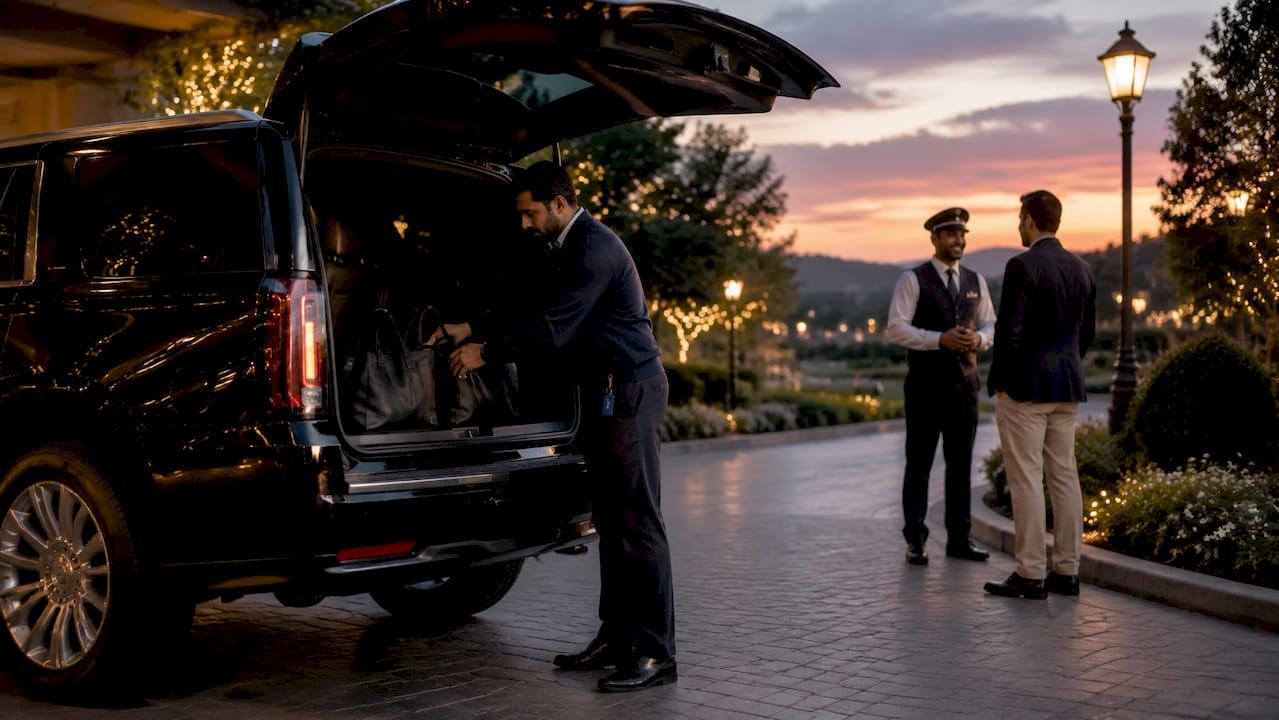
The Mercedes Sprinter executive van seats up to 12 passengers and is the best vehicle for conference shuttles, airport group pickups, and corporate roadshows. Configured with forward-facing leather seats, fold-out tables, and onboard Wi-Fi, it functions as a mobile meeting room. Stretch limousines and limousine coaches serve a different purpose: client entertainment, award dinners, and events where brand presentation carries as much weight as logistics.
Pro Tip: *Book a Sprinter van for conference shuttles instead of multiple sedans. One vehicle, one driver, and one invoice simplifies billing and keeps your group together.*
Key amenities to confirm across any vehicle class:
- Bottled water and light refreshments stocked before pickup
- Onboard Wi-Fi with confirmed connectivity, not just a hotspot
- USB-A and USB-C charging ports at every seat
- Climate control set to passenger preference before boarding
- Immaculate interior with no odors, stains, or visible wear
2\. How to compare corporate limo fleet options for your event
The right vehicle depends on four variables: group size, event type, privacy requirements, and budget. This comparison gives you a clear starting point.
| Vehicle type | Passenger capacity | Best use case | Key amenity |
|---|---|---|---|
| Executive sedan | 1–3 | Airport transfer, client dinner | Privacy glass, quiet cabin |
| Luxury SUV | 3–6 | VIP group travel, roadshows | Luggage space, elevated comfort |
| Sprinter executive van | 7–12 | Conference shuttles, team travel | Wi-Fi, conference seating |
| Stretch limousine | 8–14 | Client entertainment, galas | Bar setup, mood lighting |
| Limousine coach | 15–30 | Large group events, venue transfers | PA system, restroom |
Beyond vehicle size, two service features separate premium providers from average ones. First, corporate vehicles are often unmarked with no visible logos, which protects executive privacy and security during sensitive trips. Second, billing structure matters as much as the vehicle itself. Net-30 billing and consolidated monthly invoicing are standard in executive contracts, which simplifies internal accounting and removes the friction of per-trip expense reports.
Pro Tip: *Ask every provider whether their pricing is fixed or variable. Point-to-point corporate transfers should be flat rate with no surge or traffic multipliers. Any provider that cannot confirm this in writing is not a corporate-grade service.*
Punctuality and booking platform compatibility are non-negotiable for high-volume accounts. The most sought qualities in corporate limo clients are extreme punctuality, consistent vehicles, and integrated billing. Providers that connect with travel management platforms like Concur, TripActions, or Amex Global Business Travel give finance teams real-time visibility into ground transportation spend.
3\. What technology and service standards define premium corporate limo services?
Technology is what separates a reliable corporate limo service from a glorified taxi. The best providers build their operations around four core integrations.
- Travel management platform connectivity. Integration with Concur, TripActions, CWT, Amex, CTM, and FCM centralizes booking and expenditure tracking inside the tools your finance team already uses. This eliminates shadow spend and manual reconciliation.
- Real-time flight tracking. Flight tracking and dynamic routing protect executive time by adjusting pickup times automatically when flights are delayed or arrive early. A chauffeur who shows up 40 minutes late because a flight landed ahead of schedule is a liability, not an asset.
- Dedicated dispatch coordination. A single coordinator manages complex itineraries with multiple drivers using one dispatch sheet and planned buffer times. This is the standard for multi-city roadshows where a missed connection between legs can derail an entire day.
- NDA-trained chauffeurs. Chauffeurs sign NDAs and are trained for silent professionalism during sensitive engagements like IPO roadshows, board meetings, and investor dinners. This is not a luxury add-on. It is a baseline requirement for any executive transportation account.
Rideshare apps cannot match this level of service. Professional corporate accounts rely on limo services because rideshare platforms lack consistency and surge pricing control during critical meetings. A $14 Uber that becomes a $52 surge ride during a conference is not a corporate transportation solution.
4\. Situational recommendations for choosing the right fleet
Matching the vehicle to the scenario is where most planners either save money or waste it. These recommendations are based on common corporate event structures.
- 1.Solo executive airport transfer. Book an executive sedan. The quiet cabin, privacy glass, and single-passenger focus make it the right tool. Confirm the chauffeur has flight tracking access so pickup adjusts automatically to your actual arrival time.
- 2.Client dinner for two to four guests. A luxury SUV gives you more space and a more impressive arrival than a sedan, without the excess of a stretch limousine. The Cadillac Escalade is the standard choice for this scenario.
- 3.Small team traveling between conference venues. A luxury SUV or a six-passenger executive van handles this well. Luggage fits without cramming, and the group stays together rather than splitting across multiple vehicles.
- 4.Conference shuttle for 8–12 attendees. The Mercedes Sprinter executive van is the correct vehicle. One driver, one invoice, and a Wi-Fi-equipped cabin mean your team can work or debrief during the transfer. Check out choosing the right limo for group-specific guidance.
- 5.Multi-city corporate roadshow. This requires a dedicated coordinator, not just a vehicle. The coordinator manages all chauffeurs and legs through a single dispatch sheet, with buffer times built in between meetings. Sedans and SUVs rotate based on the day's schedule.
- 6.Client entertainment or awards gala. A stretch limousine or limousine coach delivers the brand presentation moment that a sedan cannot. For groups over 15, a limousine coach with a PA system and onboard restroom is the practical choice.
- 7.Budget-conscious executive travel. An executive sedan from a corporate-grade provider costs less than a luxury SUV and still meets every professional standard. The savings come from right-sizing the vehicle, not from cutting service quality. Limo service for businesses does not require the most expensive vehicle in the fleet to deliver a professional result.
Key takeaways
The most reliable corporate limo fleet strategy matches vehicle type to group size, event formality, and billing requirements before considering brand presentation.
| Point | Details |
|---|---|
| Vehicle age matters | All corporate-tier vehicles should be within 4 model years and detailed before every trip. |
| Fixed pricing protects budgets | Confirm flat-rate pricing with no surge charges before signing any corporate account. |
| Technology drives reliability | Real-time flight tracking and travel platform integration protect executive time on every trip. |
| NDA chauffeurs are standard | Sensitive trips require chauffeurs trained for silent professionalism and bound by NDA. |
| Right-size the vehicle | Matching vehicle capacity to group size controls cost without sacrificing service quality. |
What I've learned from watching corporate fleets succeed and fail
The planners who get corporate ground transportation right share one habit: they evaluate providers on consistency, not on the showroom quality of the fleet photos. A provider with a stunning website and aging vehicles will cost you more in reputation than in dollars.
The detail most planners overlook is chauffeur training. A well-maintained Escalade driven by someone who takes personal calls during a client transfer is a worse outcome than a modest sedan with a professional who stays silent unless spoken to. Chauffeur service standards are the actual product. The vehicle is just the packaging.
Centralized coordination is the other underrated factor. When you are running a multi-day conference with 30 attendees moving between a hotel, a convention center, and three dinner venues, a single coordinator with one dispatch sheet is worth more than any individual vehicle upgrade. The coordination layer is what prevents the 7:45 PM pickup from becoming a 8:20 PM scramble.
My honest recommendation: treat your ground transportation provider the same way you treat your AV vendor or your catering team. Vet them with a test booking before the main event. Confirm their billing setup works with your finance team's systems. And ask directly whether their chauffeurs sign NDAs. Any provider that hesitates on that last question is not ready for executive-level work.
> *— Jason*
Experience APEX LIMO's corporate fleet in Austin
APEX LIMO operates late-model executive sedans, luxury SUVs, and Sprinter vans specifically configured for corporate clients in Austin. Every vehicle is professionally detailed before each trip, and every chauffeur is trained for the discretion and punctuality that executive travel demands.

Whether you are coordinating airport transfers for a visiting board, running a conference shuttle program, or arranging client entertainment for a gala, APEX LIMO builds the logistics around your schedule. Visit the executive chauffeur service page to review fleet options and request a corporate account quote. For the full range of available vehicles, the Austin limo services page covers every fleet category APEX LIMO offers.
FAQ
What vehicles are standard in a corporate limo fleet?
Corporate limo fleets typically include executive sedans, luxury SUVs like the Cadillac Escalade, Mercedes Sprinter vans, and stretch limousines. The right vehicle depends on group size, event type, and privacy requirements.
How does fixed pricing work for corporate limo accounts?
Point-to-point corporate transfers are flat rate with no surge or traffic multipliers applied. This protects your event budget from unexpected cost spikes during high-demand periods.
Do corporate limo chauffeurs sign NDAs?
NDA agreements are standard for executive-grade limo services, particularly for sensitive trips like IPO roadshows or board meetings. Chauffeurs are also trained to remain silent unless invited to speak.
How do corporate limo services integrate with travel management platforms?
Premium providers connect directly with platforms like Concur, TripActions, CWT, and Amex Global Business Travel. This centralizes booking and gives finance teams real-time visibility into ground transportation spend.
What is the best vehicle for a corporate conference shuttle?
The Mercedes Sprinter executive van is the top choice for conference shuttles, seating up to 12 passengers with Wi-Fi, conference-style seating, and a single invoice per trip.
Recommended
- Which Limo Should You Book? Choosing the Right | Apex Limo
- How to Choose the Right Limousine Service for Your Event | Apex Limo
- Corporate Limousine Service in Austin, TX: Elevating Business Travel | Apex Limo
- Why Choose APEX LIMO for Your Next Event? | Apex Limo
Additional Planning Details: Discretion in Corporate Executive Transport: A 2026 Guide
Discretion in corporate executive transport is defined as the deliberate practice of protecting a traveling executive's identity, conversations, and movements from unauthorized exposure. The role of discretion in corporate executive transport goes far beyond simple privacy. It is an operational discipline that protects sensitive decisions, shields confidential communications, and preserves the cognitive focus executives need to lead effectively. With over 50% of C-suite executives now using AI to support strategic decisions, the data they carry and the conversations they hold during transit are more sensitive than ever. APEX LIMO builds its entire executive service model around this standard.
What is the role of discretion in corporate executive transport?
Discretion in executive transport protects three things simultaneously: confidential communications, strategic decision data, and the executive's physical visibility. Each one carries real business risk when mismanaged.
Executives frequently use transit time to discuss negotiations, personnel changes, and acquisition targets. A vehicle without controlled privacy protocols is not a mobile office. It is a liability. One in three major executive decisions is reversed or changed within 18 months, which reflects the cognitive pressure executives operate under. Reducing distraction and information leakage during transit directly supports better decision quality.

The industry term for this practice is *executive mobility management*, and it encompasses far more than booking a car. It covers route selection, chauffeur conduct, communication controls, and arrival timing. When all of these elements work together, the vehicle becomes a protected environment for high-stakes thinking.
APEX LIMO treats this not as a premium add-on but as the baseline standard for every corporate booking. That distinction separates professional executive transport from standard car services.
How does discretion support decision-making during business travel?
Executives make consequential decisions during transit more often than most organizations acknowledge. A board member reviewing acquisition terms in the back seat needs the same cognitive conditions as a conference room, not a taxi.
The concept of *cognitive quiet* is central to this. Chauffeurs trained to be unobtrusive avoid initiating conversation, minimize interruptions, and maintain silence unless directly addressed. That discipline preserves the mental bandwidth executives need for complex judgment. Removing ambient distraction is not a comfort feature. It is a performance requirement.
Discretion also prevents information leakage through indirect channels. A chauffeur who overhears a merger discussion and mentions it casually to another client creates a breach. The risk is not theoretical. It is the reason structured decision-making frameworks now explicitly require that physical transport align with enterprise governance and security standards.
- Confidential negotiations: Executives can review deal terms, legal documents, and personnel decisions without exposure.
- Strategic briefings: Pre-meeting preparation happens in a controlled environment, not a shared space.
- Sensitive calls: Calls with legal counsel, board members, or investors require acoustic and visual privacy.
- Mental recovery: Transit between high-pressure engagements gives executives uninterrupted time to reset.
Pro Tip: *Before booking any executive transport, ask the provider directly whether chauffeurs sign confidentiality agreements. If the answer is vague, the privacy standard is vague.*
What operational practices enforce discretion in executive transport?
True discretion is a system, not a personality trait. It requires documented protocols, legal agreements, and trained behavior at every point of contact.
The most effective executive transport providers build discretion into operations through the following steps:
- 1.Criminal and driving record verification. Comprehensive background checks on all chauffeurs are mandatory. This is the foundation of client trust, not an optional screening.
- 2.Non-disclosure agreements. NDAs are the industry standard for legally binding chauffeur confidentiality. They shift discretion from expectation to enforceable obligation.
- 3.Passenger data controls. Chauffeurs receive only the information needed to complete the booking. Destination details, client identity, and meeting context are shared on a strict need-to-know basis.
- 4.Route intelligence. Disciplined route planning avoids high-visibility areas, media presence, and predictable patterns that could expose an executive's movements.
- 5.Controlled arrival protocols. Timing and positioning at pickup and drop-off points are managed to minimize public exposure and paparazzi risk.
- 6.Communication discipline. Chauffeurs do not discuss previous clients, routes, or any detail of past bookings under any circumstances.
Discretion as a systemic discipline means no single element carries the full weight. The NDA protects against verbal disclosure. The route plan protects against physical exposure. The background check protects against insider risk. All three must function together.
Pro Tip: *Request a written copy of a provider's confidentiality protocol before your first booking. A provider that cannot produce one does not have one.*
How does executive transport discretion compare to standard business travel?
The gap between executive transport and standard business travel options is not about vehicle quality. It is about the depth of the privacy infrastructure behind the service.
| Feature | Executive transport services | Standard business travel options |
|---|---|---|
| Chauffeur screening | Full criminal and driving history checks | Basic license verification |
| Confidentiality agreements | NDAs required before employment | Not standard practice |
| Passenger data handling | Strict need-to-know protocols | Booking details shared broadly |
| Route planning | Customized to avoid exposure | Standard GPS routing |
| Chauffeur conduct training | Formal silence and discretion protocols | No structured conduct standard |
| Arrival management | Controlled timing and positioning | Standard pickup and drop-off |
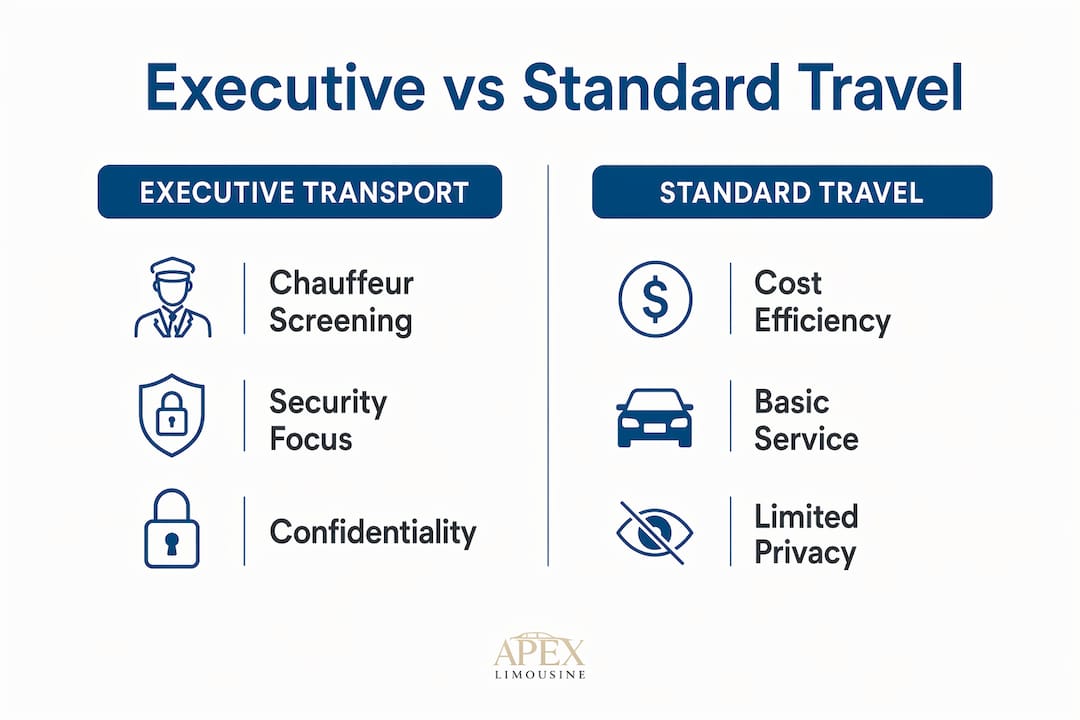
Standard car services optimize for efficiency and cost. Executive transport services optimize for security and confidentiality. That is a fundamentally different design goal. The difference shows up most clearly when something goes wrong. A leaked route, an overheard conversation, or a photographed arrival can damage a negotiation, a stock price, or a reputation.
Chauffeurs in executive services act as privacy gatekeepers, not just drivers. That role requires training, accountability, and legal structure that standard services do not provide. For executives managing enterprise risk, that gap is not acceptable.
What are the practical benefits of extreme discretion in executive transport?
Discretion in executive transport delivers measurable operational value beyond privacy protection. The benefits compound across every high-stakes trip.
- Reduced operational risk. Controlled routes and vetted chauffeurs eliminate the most common vectors for information exposure during transit.
- Higher productivity. Executives who trust their transport environment use transit time for calls, document review, and preparation. That time is otherwise lost.
- Faster decision cycles. Cognitive quiet during transit supports clearer thinking. Executives arrive at meetings prepared, not distracted.
- Preserved trust relationships. A provider who has never breached confidentiality builds a long-term relationship that becomes part of the executive's operational infrastructure.
- Brand and reputation protection. Unplanned visibility during sensitive periods, such as M&A activity or leadership transitions, carries real reputational risk. Discreet transport removes that exposure.
The professional chauffeur standards that govern executive transport are not arbitrary. They exist because the cost of a single discretion failure can far exceed the cost of years of premium service. For executives managing high-stakes decisions, that math is straightforward.
Discretion is infrastructure, not a luxury upgrade
From my experience working with corporate clients who travel at the executive level, the biggest mistake I see is treating discretion as a premium feature rather than a baseline requirement. Executives who think this way discover the gap only after something goes wrong.
The most telling indicator of a transport provider's discretion standard is not the vehicle. It is the chauffeur's behavior in the first 60 seconds. Does the driver initiate conversation? Does the driver confirm the destination loudly in a public space? Does the driver ask unnecessary questions about the meeting? These are not minor etiquette issues. They are operational failures.
I have seen executives choose transport based on vehicle aesthetics and then conduct sensitive calls in cars where the driver had no NDA, no formal training, and no route protocol. The vehicle looked right. The service was not. The two are not the same thing.
My advice is direct: evaluate your transport provider the same way you evaluate any vendor with access to sensitive information. Ask for their screening process, their confidentiality agreements, and their conduct protocols in writing. If a provider cannot answer those questions clearly, they are not operating at the executive standard. Visibility is a business risk. Treat it like one.
APEX LIMO's approach to discreet executive transport in Austin
Corporate executives who require genuine discretion need a provider built around that standard from the ground up.
APEX LIMO's executive chauffeur service in Austin is designed specifically for high-profile clients who cannot afford a privacy failure during transit. Every chauffeur undergoes rigorous background screening, operates under formal confidentiality protocols, and is trained in the conduct standards that protect sensitive communications on the move. Route planning, arrival management, and communication discipline are built into every booking. For executives who need a transport partner that treats discretion as infrastructure, APEX LIMO delivers that standard consistently. Request a free quote to discuss your executive transport requirements.
What does discretion mean in executive transport?
Discretion in executive transport means protecting an executive's identity, movements, and conversations through vetted chauffeurs, NDAs, controlled routes, and strict communication protocols. It is a systemic operational standard, not a personal preference.
Why do executives need private transport for business travel?
Executives carry sensitive data and conduct confidential communications during transit. Standard transport services lack the screening, legal agreements, and conduct protocols required to protect that information.
What is cognitive quiet in executive transport?
Cognitive quiet refers to the distraction-free environment created when a chauffeur maintains silence and avoids unnecessary interaction. It preserves executive focus and supports higher-quality decision-making during transit.
Are NDAs standard for executive chauffeurs?
NDAs are the industry standard for professional executive transport services. They create a legally binding confidentiality obligation that goes beyond informal expectations of discretion.
How does route planning protect executive privacy?
Disciplined route planning avoids high-visibility areas, predictable patterns, and locations with media presence. This reduces the risk of unauthorized observation or photography during sensitive travel periods.
Discretion in corporate executive transport is an operational system, not a service feature, and it requires NDAs, vetted chauffeurs, route intelligence, and conduct protocols working together to protect executive privacy and decision quality.
| Point | Details |
|---|---|
| Discretion is a system | Effective executive transport requires NDAs, background checks, route planning, and conduct protocols together. |
| Cognitive quiet drives productivity | Trained chauffeurs who avoid distraction protect executive focus and improve decision quality during transit. |
| Standard services fall short | Generic transport options lack the legal agreements and conduct training required for executive-level privacy. |
| Visibility is a business risk | Uncontrolled executive movements during sensitive periods can damage negotiations, stock prices, and reputations. |
| Provider vetting is non-negotiable | Executives should request written confidentiality protocols and screening records before selecting any transport provider. |
Related Pages for Your Transportation Plan
Review the passenger manifest, meeting schedule, and coordinated business pickups. Review our Corporate Transportation for service and booking details.
Share your pickup locations, passenger count, and schedule to request a corporate transportation quote.
- Why Group Corporate Transport Needs Coordination — Effective coordination is vital for group corporate transport, ensuring smooth operations and accountability. Learn how to secure success.
- Corporate Transport Vendor Criteria: Top 12 for Procurement — Discover essential corporate transport vendor criteria to ensure timely service and safety. Learn how to streamline your procurement process now!
Planning travel beyond Austin?
- Austin to Dallas car service — If your itinerary includes Dallas, confirm the destination, stops, and return travel when requesting a quote.
- Austin to San Antonio car service — If your itinerary includes San Antonio, confirm the destination, stops, and return travel when requesting a quote.
- Austin to Houston car service — If your itinerary includes Houston, confirm the destination, stops, and return travel when requesting a quote.
Our Fleet
Our Services
Venue Transportation
Ready to Book?
Experience Austin in Luxury
Get a personalized quote for your Austin transportation needs — wedding, airport, corporate, or a night out.
Get a Free Quote