

Why Group Corporate Transport Needs Coordination
Effective coordination is vital for group corporate transport, ensuring smooth operations and accountability. Learn how to secure success.
Group corporate transport needs coordination because without a single accountable plan, you are not moving a group — you are managing dozens of individual trips that can each fail independently. The essential elements every planner must secure before the first vehicle moves:
- Single source of truth: One shared document or platform that holds every pickup time, location, vehicle assignment, and passenger manifest.
- Anchor times: Fixed departure windows that the entire schedule is built around, not aspirational estimates.
- Vehicle matching: The right capacity for each leg, confirmed against the actual headcount, not the RSVP list.
- Communication channel: A direct line between the planner, the dispatcher, and the on-site lead — not a group text with 40 people in it.
- Contingency plan: A named backup vehicle, a secondary pickup window, and an escalation contact for every critical movement.
When the group is small and the event is a single venue, a capable in-house coordinator with a shared itinerary can manage it. As groups grow larger or involve multiple venues or VIP requirements, the coordination complexity increases significantly, and a specialized provider can add value.
---
Key Takeaways
Coordinated group corporate transport is a risk management and operational decision: without a manifest, anchor times, and a single accountable coordinator, each vehicle movement is an independent failure point.
| Point | Details |
|---|---|
| Coordination scales nonlinearly | Groups of 20 or more require structural tools and distributed visibility, not just a bigger spreadsheet. |
| Loading time drives delays | Budget at least 10 minutes per vehicle for boarding — transit time is predictable, loading time is not. |
| Start 8–12 weeks out | Lead time under eight weeks for a mid-size event is the most common cause of deposit and manifest failures. |
| Document vendor compliance | Collect insurance certificates, driver background check policies, and vehicle inspection logs before signing. |
| APEX LIMO for Austin events | Provides chauffeur service, fleet documentation, and custom quotes for corporate groups of any size in Austin. |
---
Table of Contents
- Why does group corporate transport need coordination?
- What do you actually gain from coordinated group transport?
- What does a transportation coordinator actually do?
- Your planner checklist from booking to post-event
- What goes wrong with group transport plans, and how do you fix it?
- Which tools help you coordinate group transport effectively?
- Transport coordination as a strategic lever, not just a logistics task
- U.S. safety and compliance checklist for corporate group transport
- When a specialized transport provider makes sense for your event
- Sources
Why does group corporate transport need coordination?
The Federal Transit Administration defines transportation coordination as an organized effort among multiple entities to deliver components of a transportation service so trips can be provided more efficiently and without duplication. For corporate planners, that definition translates into something concrete: coordinated movement means one accountable flow with a manifest, anchor times, staged vehicles, and documented service-level agreements. Ad hoc transport means a collection of one-off trips, each booked separately, each with its own failure mode.
> Coordinated group transport is not a logistics upgrade — it is a risk management decision. When a single missed pickup can cascade into a delayed keynote, a stranded VIP, or a blown airport connection, the cost of coordination is almost always lower than the cost of the failure it prevents.
The core components of a coordinated plan are worth naming explicitly:
- Manifest: A passenger-level list tied to each vehicle and departure time.
- Anchor times: Non-negotiable departure windows that every other schedule element respects.
- Staging: Pre-assigned curb positions, vehicle order, and load sequence.
- Dispatch: A single person or system that can redirect vehicles in real time.
- SLAs: Written commitments from the provider on response windows, fleet standards, and escalation paths.
These components map directly to the most common corporate event types. Airport transfer runs need manifests and anchor times. Offsite moves need staging and dispatch. Multi-venue conference days need all five, plus a contingency vehicle on standby.
---
What do you actually gain from coordinated group transport?
Punctuality is the most visible benefit, but it is not the only one. Coordination effort grows nonlinearly with group size — a group of 25 is not five times harder to move than a group of five; it is structurally different. Without a coordinated plan, the planner becomes the traffic controller, fielding individual questions, rerouting stragglers, and absorbing every delay personally.
On-time performance improves when anchor times are locked and vehicles are staged before attendees arrive. The single most underestimated variable is loading time. Transit time is predictable; loading time is not. A 40-person group boarding a coach without a staged manifest can add 12–18 minutes to a departure that was planned for five. Build that buffer into every pickup window.
Cost per person often drops with consolidation. Dispersed reimbursements for rideshares and personal vehicles carry hidden costs: mileage claims, parking fees, and the administrative overhead of reconciling receipts across a department. A chartered vehicle with a fixed rate and a documented headcount is easier to budget, easier to audit, and often cheaper per seat once the full loaded cost is calculated.
Attendee experience and brand impression are harder to quantify but easy to lose. The first thing a guest experiences at a corporate event is often the pickup. A vehicle that is late, in the wrong location, or driven by someone who does not know the venue entrance sets a tone that the rest of the program has to overcome. Reliable transport, by contrast, gives attendees time to network, decompress, or prepare — which is exactly what the event was designed for.
Risk reduction covers two distinct categories. The first is operational: missed connections, stranded attendees, and schedule cascades. The second is legal: liability exposure from unvetted drivers, gaps in commercial insurance, and ADA accessibility failures. Both categories shrink when coordination is documented and vendor requirements are written into a contract.
---
What does a transportation coordinator actually do?
The role is more specific than "books the buses." A transportation coordinator owns the following tasks, and each one should be assigned to a named person or vendor before the contract is signed:
- 1.Requirement gathering: Collect headcounts, pickup locations, accessibility needs, and schedule constraints from the event brief.
- 2.Vendor sourcing: Qualify providers on fleet condition, insurance coverage, driver vetting, and SLA terms.
- 3.Manifesting: Build and maintain a passenger-level manifest tied to each vehicle and departure time.
- 4.Scheduling: Lock anchor times and build the full movement schedule against the event program.
- 5.Staging: Assign curb positions, vehicle order, and load sequence for each pickup location.
- 6.On-day communication: Maintain a live channel between the dispatcher, the on-site lead, and the venue contact.
- 7.Contingency execution: Activate backup vehicles or alternate routes when a primary plan fails.
- 8.Post-event reconciliation: Confirm actual usage against the manifest, collect receipts, and document any service failures for future vendor evaluation.
What to require in an SLA or statement of work: response windows of 15 minutes or less for on-day issues, a named escalation contact above the dispatcher, fleet inspection records dated within the past 12 months, commercial general liability coverage at the level your procurement team requires, and explicit cancellation and rebooking terms.
The operational handoff between planner, venue, and provider is where single-point-of-failure risks concentrate. The planner owns the manifest and the schedule. The venue owns the curb and the staging area. The provider owns the vehicles and the drivers. When those three parties have not agreed on who controls the curb during load-out, you get three people giving conflicting instructions to 40 attendees.

Pro Tip: *Assign one named on-site transport lead who is not also managing the event program. The person watching the curb cannot simultaneously be managing the speaker lineup.*
---
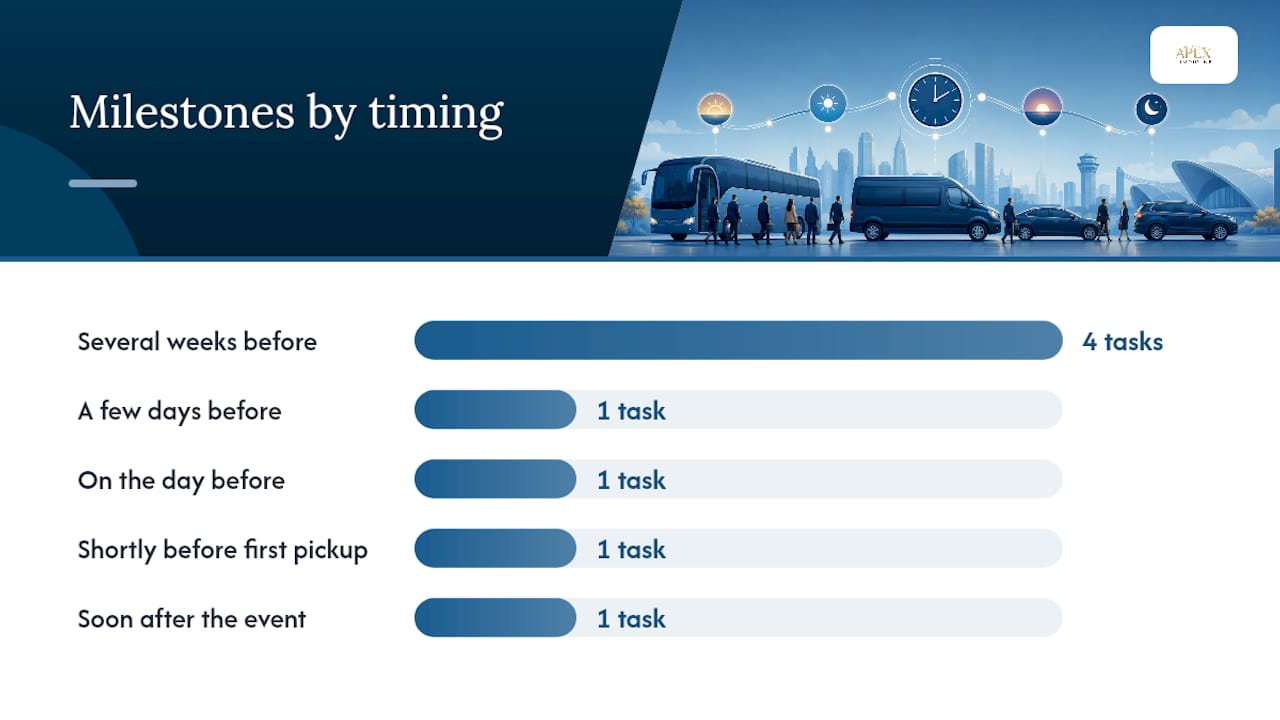
Your planner checklist from booking to post-event
The timeline below is built around a mid-size corporate event. Adjust lead times appropriately for larger groups or multi-city moves.
| Milestone | Timing | Action |
|---|---|---|
| Initial booking and deposit | Several weeks before the event | Confirm vehicle types, headcount estimate, anchor times, and deposit terms in writing |
| Manifest first draft | Several weeks before the event | Collect names, pickup locations, accessibility needs, and flight arrival windows |
| ADA and accessibility confirmation | Several weeks before the event | Verify accessible vehicle availability and confirm with attendees who need it |
| Vendor confirmation call | Several weeks before the event | Review manifest, staging plan, and SLA terms with the provider's operations contact |
| Final manifest lock | A few days before the event | Freeze the passenger list; communicate changes only through the designated channel |
| Driver briefing document | On the day before the event | Send each driver the manifest, pickup locations, building entrances, and dispatcher contact |
| On-site staging check | Shortly before first pickup | Walk the curb, confirm vehicle positions, verify signage, and test the communication channel |
| Post-event reconciliation | Soon after the event | Compare actual usage to manifest, collect receipts, and document any service gaps |
On-site staging specifics: Assign a vehicle number and curb position to each departure. Post signage at the pickup point that matches what attendees received in their pre-event communication. Never rely on attendees to find the right vehicle by description alone.
A living itinerary and mobile-friendly source of truth reduce lobby and curb-side failures more than any other single intervention. Send it to attendees 24 hours before the first pickup, not the morning of.
Starting too late and using fragmented communication are the two most common reasons group travel plans fail. Eight weeks is the minimum lead time for a mid-size event; 12 weeks is safer for anything involving 50 or more attendees, multi-venue moves, or VIP requirements.
---
What goes wrong with group transport plans, and how do you fix it?
Most transport failures trace back to a small set of recurring mistakes. Recognizing them before the contract is signed is cheaper than fixing them on event day.
Common failure modes:
- Single point of failure with the planner: When the lead planner is also the only person who knows the manifest, a phone call at the wrong moment can strand a vehicle.
- Poor pickup staging: Vehicles arrive in the wrong order, block each other, or park at the wrong entrance because no one walked the curb in advance.
- Underestimated loading time: Planners budget transit time but not boarding time. For groups over 20, add at least 10 minutes per vehicle to every departure window.
- Mixed vehicle sizing: Booking a 15-passenger van for a group that grows to 22 at registration close creates a problem with no good day-of solution.
- Fragmented communications: Attendees texting the planner directly, drivers calling a personal cell, and venue staff using a separate channel produce three versions of the truth simultaneously.
Red-flag checks before you sign:
- No after-hours dispatch number in the contract.
- Insurance certificate that names a different entity than the one you are contracting with.
- Manifest template that captures vehicle assignment but not individual passenger names.
- No written cancellation or rebooking terms.
Quick contingency playbook items: Identify a secondary vehicle source before the event, not during it. Build a 15-minute pickup window into every departure rather than a single fixed time. Keep a standby contact at the provider who can authorize a vehicle change without going through the main booking line.
Pro Tip: *Run a five-minute staging drill with your on-site transport lead two hours before the first pickup. Walk from the lobby to the curb, confirm vehicle positions, and verify that the dispatcher's number is saved in at least two people's phones.*
---
Which tools help you coordinate group transport effectively?
The right tool mix depends on group size and event complexity. A shared Google Doc and a group text can handle a 10-person offsite. A 75-person multi-venue conference day needs more structure.
Tool categories and what they do:
- Itinerary platforms (TripIt Pro, Travefy, Groupize): Serve as the single source of truth for schedules, pickup times, and vehicle assignments. Best for events where attendees need mobile access to their own movement details.
- Dispatch and real-time tracking tools (Samsara, Verizon Connect, provider-native apps): Give the on-site lead visibility into vehicle location and ETA. Critical for airport transfer runs with variable flight arrivals.
- Group messaging platforms (Slack channels, WhatsApp groups, event apps): Separate the transport communication channel from the general event channel. Reduces noise and makes it easier to find time-sensitive updates.
- Booking and manifesting tools (Cvent, event-specific transport modules): Collect attendee travel details at registration and auto-populate manifests. Saves hours of manual data entry for large groups.
- Expense reconciliation platforms (Concur, Expensify): Close the loop on cost-per-person tracking and simplify post-event reporting.
For groups under 20, a shared spreadsheet manifest plus a dedicated group chat is usually sufficient. Once you cross 20 attendees, coordination at scale requires structural approaches — threshold-based locks on the manifest, distributed visibility so multiple team members can see vehicle status, and a platform that does not require every update to go through one person.
Adoption considerations: The best tool is the one your team and your provider will actually use. A sophisticated dispatch platform that the driver's company does not support creates more friction than a well-maintained spreadsheet. Confirm tool compatibility with your provider before the event, not after.
---
Transport coordination as a strategic lever, not just a logistics task
Treating corporate ground transportation as a strategic business decision yields gains that go beyond on-time departures. Progressive organizations are measuring transport coordination against three strategic KPIs: productivity recovered, retention impact, and ESG contribution from trip consolidation.
Simple KPIs worth tracking:
- On-time percentage: Departures that left within five minutes of the anchor time, divided by total departures.
- Cost per person per leg: Total transport spend divided by actual headcount, tracked across events to identify trends.
- Attendee satisfaction score: A single post-event survey question about transport experience, benchmarked across events.
- Consolidated trips vs. individual trips: The number of vehicle movements avoided by using group transport instead of individual rideshares or personal vehicles.
The productivity case is straightforward. An attendee who arrives on time, without the stress of navigating an unfamiliar city, is ready to engage from the first session. An attendee who spent 20 minutes in a rideshare app and arrived late is not.
The retention and ESG cases are less obvious but increasingly relevant to procurement teams. Reducing commute-related stress and demonstrating that the organization manages travel thoughtfully both contribute to employee experience scores. Consolidated trips reduce vehicle movements, which translates into a reportable reduction in emissions for organizations tracking Scope 3 travel data.
Pro Tip: *To estimate avoided vehicle trips, divide total group headcount by average vehicle occupancy for your event type, then subtract the number of vehicles actually deployed. That delta is your consolidation figure. Report it alongside cost-per-person in your post-event summary.*
---
U.S. safety and compliance checklist for corporate group transport
Vendor documentation is not a formality. It is the paper trail that protects your organization if something goes wrong.
Documents to collect before the contract is signed:
- Certificate of insurance naming your organization as an additional insured, with commercial auto liability and general liability limits that meet your procurement threshold.
- Driver background check policy: confirm the provider runs checks through a recognized screening service and at what frequency.
- Vehicle inspection logs dated within the past 12 months.
- FMCSA operating authority number (for interstate moves) or state-level equivalent for intrastate charters.
- ADA accessibility confirmation for any event where attendees have documented mobility needs.
The U.S. Department of Transportation provides federal guidance and program resources that planners can reference when building procurement language for vendor contracts, particularly for compliance requirements on federally funded or regulated events.
On-site safety checks before the first pickup:
- Walk every pickup and drop-off location to confirm vehicle access, curb clearance, and pedestrian separation.
- Verify that each driver has the manifest, the building entrance address (not just the street address), and the dispatcher's direct number.
- Confirm that accessible vehicles are positioned first in the staging order when needed.
- Identify the emergency contact at the venue and confirm they know the transport coordinator's number.
How to phrase safety requirements in a vendor contract: Require the provider to certify in writing that all drivers hold a valid commercial driver's license (CDL) where required by vehicle class, that vehicles meet state inspection standards, and that the provider carries continuous insurance coverage for the duration of the event. Include a clause requiring notification within one hour of any vehicle substitution.
---
What actually works on event day: a provider's perspective
The single practice that prevents more day-of failures than any other is issuing a mobile-friendly source of truth to every stakeholder — attendees, drivers, the on-site lead, and the venue contact — at least 24 hours before the first pickup. Not a PDF attachment. A link they can open on a phone, with the exact building entrance, the dispatcher's number, and the anchor times in large text at the top.
For hotel pickups with mixed arrival windows, stage vehicles in 20-minute departure blocks rather than a single fixed time. Attendees who arrive early board and wait; the vehicle departs at the block time regardless. This absorbs the natural spread of a group without cascading every departure.
At airports, the staging challenge is reversed: the vehicle waits for the attendees, not the other way around. Build a 30-minute buffer after the last scheduled arrival before the first departure, and assign one person to monitor the arrivals board rather than relying on attendees to self-report.
Venue and security relationships matter more than most planners expect. A venue coordinator who knows your vehicle staging plan will hold the curb for you. One who does not will fill it with catering trucks. Make that call two weeks out, confirm it in writing, and walk the curb together the day before.
---
When a specialized transport provider makes sense for your event
If your event involves more than 20 attendees, multi-venue moves, VIP guests with elevated service expectations, or any liability exposure that your organization's standard insurance does not cover, the case for a specialized provider is strong. The coordination complexity at that scale is not a matter of effort — it is a matter of infrastructure that most in-house teams do not have standing up.

A good provider brings 24/7 dispatch, documented fleet maintenance records, a named operations contact for your event, and a manifest system that does not depend on your team to maintain it. For Austin-based events, APEX LIMO offers luxury SUV and chauffeur service for executive groups and VIP transfers, with vehicle options ranging from sedans to coaches and a planning process built around the kind of documentation this article describes. Whether you need a single airport transfer or a full conference group transportation plan across multiple venues, the starting point is a custom quote that reflects your actual headcount, schedule, and service requirements. Reach out at Austinapex to confirm availability and get a quote before your preferred dates close.
---
Sources
These sources are worth bookmarking when you are building procurement language, validating compliance requirements, or making the case internally for a coordinated transport budget.
- Transportation Coordination | FTA
- About DOT | U.S. Department of Transportation
- Corporate Team Travel Planning: How to Keep Everyone On Time (and Comfortable) | Luxedvans
- Tripti
- Why is coordinating group travel so complicated? | Eventhotelstay
- Why Corporate Ground Transportation Is Becoming a Strategic Business Decision | BOSS Magazine
Recommended
- Company Offsite Transportation Austin Guide | Apex Limo
- Why Executive Event Transport Differs from Standard Service
- Corporate Event Transport Types: A 2026 Planner's Guide
- Corporate Event Transportation Austin Guide | Apex Limo
Plan the Complete Journey
For the complete planning framework, see our Austin corporate transportation guide.
Explore Austin executive chauffeur services for your trip.
Our Services
Serving Austin and surrounding Central Texas communities. View all service areas →
Ready to Book?
Experience Austin in Luxury
Get a personalized quote for your Austin transportation needs — wedding, airport, corporate, or a night out.
Get a Free Quote