What Is Corporate Event Shuttle Service? A Planner's Guide
Learn what is corporate event shuttle service and how it benefits planners. Discover how to efficiently transport attendees for a seamless experience.
A corporate event shuttle service is a professionally managed, scheduled transportation solution that moves attendees between hotels, airports, and venues on repeated, coordinated runs. Unlike a one-time coach hire, it involves route planning, passenger flow management, and real-time dispatch control. Event planners and corporate professionals rely on these services to keep large groups moving on time, reduce logistical friction, and protect the guest experience from the moment attendees arrive. Understanding what is corporate event shuttle service means understanding the difference between simply booking a bus and running a managed mobility operation.
What is corporate event shuttle service and how does it work?
A corporate shuttle service is defined by its scheduled, repeating structure. Corporate shuttles handle repeated attendee flows with dispatch and schedule control, unlike one-off coach hires that drop a group once and leave. That distinction matters enormously at a multi-day conference where the same hotel-to-venue route runs six times a day.
The core components are route design, timed departures, and a dispatcher who monitors vehicle positions and adjusts in real time. A shuttle program for a 500-person conference in Austin might run three vehicles on a 20-minute loop between two hotels and the convention center, with a fourth vehicle on standby for overflow. Each run is logged, each vehicle is tracked, and the dispatcher can redirect a bus if one stop backs up.

Corporate shuttle services differ from rideshares by operating scheduled, route-based transport for groups rather than responding to individual ride requests. Rideshares scale poorly for large groups. When 200 attendees leave a keynote at the same time, individual app-based rides create a chaotic queue and unpredictable costs. A shuttle program absorbs that surge in three coordinated runs.
Common use cases include hotel-to-venue loops, airport group transfers, and multi-site event circuits. A pharmaceutical company hosting a national sales meeting, for example, might need airport pickups across two terminals, a nightly dinner shuttle to a restaurant 10 miles from the hotel, and a closing-day transfer to the airport. Each leg requires its own schedule, vehicle allocation, and contingency plan.
Shuttle service vs. standard transport options
| Feature | Corporate shuttle service | Standard coach hire | Rideshare |
|---|---|---|---|
| Scheduling | Repeated timed runs | Single trip | On demand |
| Dispatch control | Yes, real time | No | Automated |
| Group capacity | 15–55 passengers per vehicle | 40–55 passengers | 1–4 passengers |
| Cost predictability | Fixed program rate | Fixed per trip | Variable |
| Brand consistency | Uniformed, branded | Varies | None |
| Best for | Multi-run event loops | Single group transfer | Individual travel |
How to schedule corporate event shuttles for maximum efficiency
Scheduling is where most corporate shuttle programs succeed or fail. Over-scheduling leads to wasted resources and empty vehicles, while under-scheduling causes attendee frustration from long waits. The goal is matching vehicle capacity to demand at each point in the event agenda.
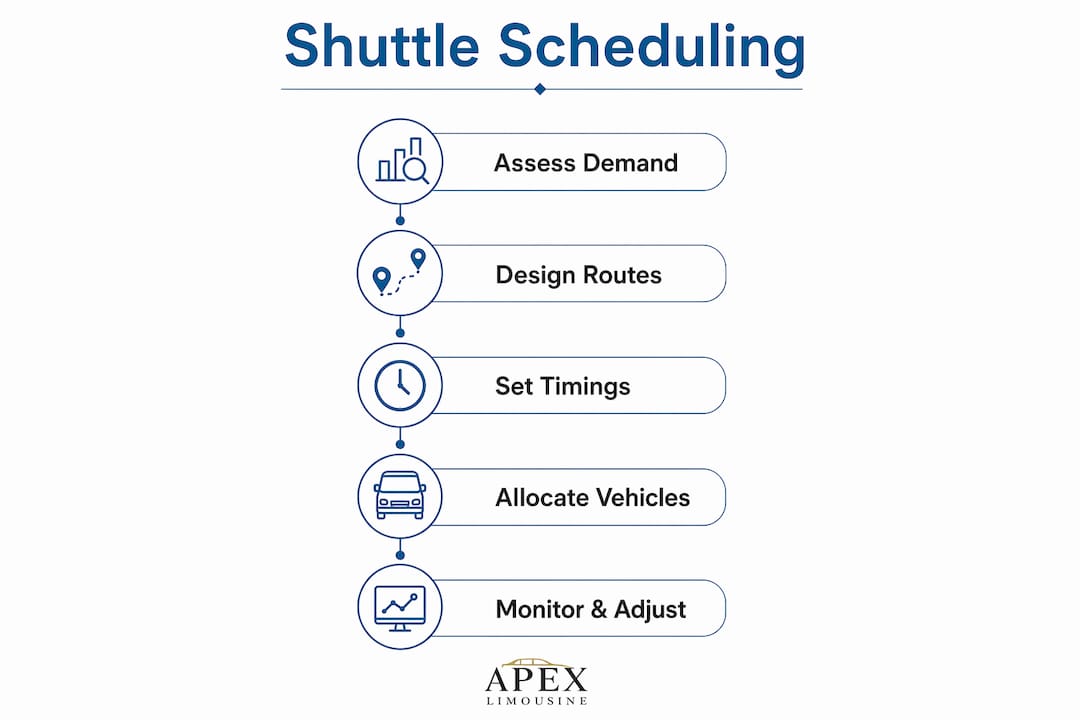
The most reliable scheduling method maps shuttle departures directly to the event program. Planning shuttle demand from the event agenda allows planners to anticipate peak attendee flows, such as a post-keynote surge concentrated in a 12-minute window. Knowing that 400 people will exit a general session at 10:45 a.m. tells you exactly how many vehicles to stage at the venue door at 10:40 a.m.
A practical scheduling process follows these steps:
- 1.Pull the event agenda. Identify every session start, break, meal, and closing time. These are your demand triggers.
- 2.Estimate attendee flow per trigger. Use registration data and historical attendance patterns to assign a headcount to each departure window.
- 3.Calculate vehicle runs needed. Divide the headcount by vehicle capacity, then add one run for overflow.
- 4.Set departure intervals. For high-volume windows, run vehicles every 10–15 minutes. For low-volume periods, extend to 30-minute intervals.
- 5.Build in buffer time. An 8–10 minute buffer when coordinating shuttles with public transit prevents cascading delays across the entire schedule.
- 6.Assign a dispatcher. One person must own real-time adjustments. Without a dispatcher, a single traffic delay can unravel the entire program.
A corporate event shuttle schedule template typically includes columns for route name, vehicle ID, departure time, stop sequence, estimated arrival, and actual departure. Sharing that template with hotel concierge staff and venue coordinators keeps everyone aligned.
Pro Tip: *Build your shuttle schedule in 15-minute blocks tied to the event agenda, not arbitrary clock times. When the agenda shifts, your shuttle schedule shifts with it automatically.*
What vehicle types work best for business event shuttles?
Vehicle choice directly shapes how guests perceive the event. Corporate shuttle vehicle types include coach buses, minibuses, and luxury shuttles, each suited to different group sizes and event tones. Sending a 55-seat coach for a 12-person executive dinner signals poor planning. Sending a 14-passenger minibus for a 40-person group creates three extra runs and frustrated attendees.
The main vehicle categories and their best uses:
- Minibus (14–24 passengers). Best for executive transfers, VIP groups, and off-site dinners. Easier to park at urban venues and faster to load than a full coach.
- Coach bus (40–55 passengers). The workhorse of large conference shuttles. High capacity, comfortable seating, and luggage storage make it the right choice for airport transfers and main venue loops.
- Luxury shuttle or sprinter van (8–14 passengers). Ideal for C-suite groups, board meetings, and events where brand image carries weight. Leather seating, climate control, and onboard technology signal a premium experience.
Amenities matter beyond seat count. Climate control is non-negotiable for summer events in Austin, where temperatures regularly exceed 95°F. Onboard Wi-Fi lets attendees stay productive during transfers. USB charging ports are a small detail that generates consistent positive feedback from guests.
Pro Tip: *For multi-day conferences, assign the same vehicle and driver to VIP routes each day. Consistency builds trust and eliminates the awkward "where's my shuttle?" moment for senior executives.*
Vehicle choice also carries a brand signal. A Fortune 500 company running a national sales meeting in a fleet of clean, uniformed luxury shuttles communicates operational excellence before the first session starts. A mismatched fleet of rental vans communicates the opposite.
How to integrate shuttle services into your full event logistics plan
A shuttle program does not operate in isolation. A managed mobility program combining airport transfers, venue shuttles, and executive transport through one provider delivers consistent branding, better reporting, and improved safety compliance. Fragmented providers create gaps. One company handling airport pickups and a different company running venue loops means two dispatch systems, two points of failure, and no unified view of attendee movement.
The integration framework for a full corporate event looks like this:
| Logistics layer | Shuttle role | Key coordination point |
|---|---|---|
| Airport arrivals | Group transfer to hotel | Flight manifest, baggage claim timing |
| Hotel to venue | Repeated loop runs | Event agenda, lobby call times |
| Off-site dinners | Point-to-point transfer | Restaurant reservation time |
| Executive transport | Dedicated vehicle, priority routing | Executive itinerary, security protocols |
| Airport departures | Group transfer from hotel | Checkout times, flight windows |
Real-time tracking technology is the connective tissue of this system. Experienced dispatchers use dynamic fleet redeployment tools and real-time tracking to reduce wait times without increasing fleet size or budgets. A dispatcher watching a live map can see that a vehicle is running 7 minutes late and immediately redirect a nearby standby unit to cover the stop.
Communication protocols matter as much as technology. Attendees need a single point of contact, whether that is a shuttle hotline, a WhatsApp group, or a dedicated event app notification. When a vehicle is delayed, a proactive message to waiting guests eliminates the anxiety of not knowing. That single communication step consistently ranks as a top driver of positive shuttle feedback in post-event surveys.
For conference group transportation in Austin, planners should also account for local traffic patterns. Events at the Austin Convention Center during South by Southwest or a major UT home game face entirely different road conditions than a mid-week corporate retreat. Building local knowledge into the route plan is not optional. It is the difference between a shuttle program that runs on time and one that generates complaints.
Key Takeaways
A corporate event shuttle service succeeds when scheduled departures match attendee demand, vehicles fit the group size, and one provider manages all mobility layers under a unified dispatch system.
| Point | Details |
|---|---|
| Definition matters | Corporate shuttles run repeated, scheduled routes with dispatch control, not single-trip coach hires. |
| Schedule to the agenda | Map shuttle departures to session end times to absorb attendee surges without adding vehicles. |
| Buffer time prevents failures | Build an 8–10 minute buffer into any shuttle leg connecting to public transit or airport arrivals. |
| Vehicle choice signals brand quality | Match vehicle type and amenities to group size and event tier to protect the guest experience. |
| Unified providers outperform fragmented ones | One provider managing airport, venue, and executive transport delivers better reporting and fewer gaps. |
Why I think most planners underestimate shuttle logistics
Event planners routinely nail the venue, the catering, and the AV. The shuttle program gets booked two weeks out with a single call to a charter company. That gap is where events quietly fall apart.
The most common mistake I see is treating the shuttle as a commodity. A bus is a bus, until 300 attendees are standing in the rain at 10:50 p.m. because the last run left early and no one had a dispatcher's number. The shuttle is the first and last impression of your event. Attendees remember a chaotic departure long after they forget the keynote speaker.
The second mistake is ignoring the agenda connection. Planners build detailed run-of-show documents for every session and then hand the shuttle company a start time and an end time. That is not enough. The shuttle schedule needs to mirror the agenda at the 15-minute level, with a named person responsible for real-time adjustments.
The fix is simpler than most planners expect. Treat the shuttle program as a managed mobility operation from day one. Assign a dedicated coordinator, build a schedule template tied to the agenda, and require real-time tracking from your provider. Those three steps eliminate the majority of shuttle failures I have seen across dozens of corporate events.
> *— Jason*
How APEX LIMO handles corporate event shuttle services in Austin
APEX LIMO delivers professional corporate event transportation for conferences, corporate retreats, and multi-day business events across Austin. The fleet covers every tier of group transport, from luxury sprinter vans for executive teams to full-size coach buses for large conference loops. Every program includes a dedicated coordinator, real-time vehicle tracking, and uniformed chauffeurs trained for high-volume event environments.

APEX LIMO builds each shuttle program around your event agenda, not a generic schedule. Whether you need airport group transfers for arriving attendees or a full hotel-to-venue loop for a 400-person conference, the team handles dispatch, contingency routing, and guest communication from a single point of contact. Contact APEX LIMO to build a tailored shuttle plan for your next corporate event in Austin.
FAQ
What is a corporate event shuttle service?
A corporate event shuttle service is a professionally managed transportation program that moves attendees between hotels, airports, and venues on scheduled, repeated runs. It differs from a one-time coach hire by including route planning, real-time dispatch, and passenger flow management.
How does a corporate shuttle service differ from rideshare?
Corporate shuttles operate on fixed schedules for groups, while rideshares respond to individual on-demand requests. Shuttles are more cost-effective and reliable for large groups, especially during post-session surges when hundreds of attendees need transport simultaneously.
What vehicles are used for corporate event shuttles?
Common vehicle types include minibuses (14–24 passengers), coach buses (40–55 passengers), and luxury sprinter vans (8–14 passengers). The right choice depends on group size, event formality, and the amenities required for the guest experience.
How far in advance should I book a corporate shuttle service?
Booking 6–8 weeks before the event is standard for large conferences. High-demand periods in Austin, such as major conventions or university events, require earlier booking to secure the right fleet size and vehicle types.
What should a corporate event shuttle schedule template include?
A solid template includes route name, vehicle ID, departure time, stop sequence, estimated arrival, and actual departure time. Sharing this template with hotel staff and venue coordinators keeps all parties aligned and reduces communication gaps on event day.
Recommended
- Corporate Event Transportation Austin Guide | Apex Limo
- Conference Group Transportation Austin Guide | Apex Limo
- SXSW Corporate Transportation Austin Guide | Apex Limo
- Austin Convention Center Shuttle Service Guide | Apex Limo
Plan the Complete Journey
For the complete planning framework, see our Austin corporate transportation guide.
Explore Austin executive chauffeur services for your trip.
Our Services
Serving Austin and surrounding Central Texas communities. View all service areas →
Ready to Book?
Experience Austin in Luxury
Get a personalized quote for your Austin transportation needs — wedding, airport, corporate, or a night out.
Get a Free Quote